Tuesday, October 25, 2016

Sarasota Bound: Cruising Plans

It's that time again.

On Tuesday morning November 1 at 7:00 AM, we depart for the 1,430 NM voyage to Sarasota. Assuming cooperative weather (attention sea gods) and no mechanical issues, the plan is to run six and a half days direct to Clewiston Florida with a two hour pit stop in Morehead City. Then take two more days to finish the Okeechobee Waterway and run north from Fort Myers to Sarasota.  I'm estimating arrival in Sarasota at 2:00 PM. My ability to make this schedule is pretty good, again assuming no weather issues, as I can increase speed as necessary.

Explanatory Note: When you are running 24 hours a day, a 1 knot increase is speed adds 24 nautical miles or a time reduction of three hours each day. Two days of running knocks off 6 hours. Of course there is a  corresponding fuel penalty. The 63 will burn an an additional 5 gallons per hour to run at 1600 RPMs. That translates into 120 gallons per day. Since we carry 1,300 gallons and will have full tanks leaving Morehead City the extra fuel consumption is not a problem.

Essentially, I hope to replicate what we did last November, when we knocked off an entire day's travel by getting to Clewiston, which is located on the southwest end of Lake Okeechobee, on the seventh day. While optimistic, this plan is doable. The key is getting past the Mayaka Lock before 5:00 PM, when the lock closes. You will notice in the detailed plan below that I'm estimating arrival at the Mayaka Lock at 15:26 (3:26 PM). Again this is based on last year's run. Once on Lake Okeechobee we have clear sailing to Clewiston. The only "problem" is that the sun sets at 17:36 (5:36 PM). This will necessitate running the last 90 minutes in the dark. Considering that the final stretch (see photos below) is well marked, along with our night vision and the fact that I have a programmed route, that I've run twice before, the problem is surmountable.


Besides the sunset, it turns out that there are two more "wrinkles." First, Lake Okeechobee" water levels are high at 15.7 feet. Second, the Ortona Lock is under construction which necessitates limited openings.

Southwest segment of Okeechobee Route 1
The final stretch  is a narrow but well marked channel
The first wrinkle has two implications. The first is good. The water level on Route 1 is 9.26 feet. Last May we noted clearance of only 2 feet at the southern section of Route 1; now we have close to 5. The second implication is that the Clewiston Lock is now operating. Last May, and in fact on all of our previous trips, it was open 24/7. However, this does not pose a problem as long as we are on schedule (7:00 PM arrival). The lock closes at 8;00 PM giving us a 60 minute buffer.

Now to the Ortona Lock, The Okeechobee Waterway website shows a Notice to Mariners indicating that the lock is under construction until October 14. I called to the lockmaster today and learned that the construction will last until November 18. Planned closures are between 7:30 AM to 11:30 AM and 12:30 PM to 4:30 PM Monday through Friday. As indicated by the proposed plan below, we should arrive at the lock at 12:09 PM. Back to the Clewiston Lock. Fortunately it opens at 5:30 AM. Allowing for locking time we should be clear of the lock and on our way by 6:00 AM. However, we are looking at a crack-of-dawn departure from Roland Martins Marina which is located inside the Clewiston Lock.

This year's crew consists of myself, Guy Aries and Morgan Watt. Guy has experience with this trip having accompanied me last year with Skip Roper. Guy is an experienced boater with a captains license. Morgan Watt, who is flying in from Sarasota, is also highly experienced. He too has a captains license along with years of experience as a commercial pilot. This is my most experienced crew to date.

Now to the weather. As of today (Tuesday) we have limited information as NOAA marine forecasts only go out six days. That said, at Day 6, Sunday, NOAA is showing high pressure dominating the east coast with the isobars (pressure gradient) far apart. This makes for light winds. Our Tuesday departure will depend on how fast that high moves off the coast and what fills in behind it. The other critical factor is tropical depressions, storms and hurricanes. At the moment there is no tropical activity in the Atlantic. Obviously this can change but as a general rule, the hurricane season is over by November 30 and storms are rare in November. Our insurance company requires us to stay north of Cape Hatteras until November 15. However, we have "special dispensation" to cross the boundary a few days early. However, that comes with a $200,000 wind deductible.

Finally, we have food. The captain and the crew must be fed. This year, Chef Bernard Kinsella at Good life Kitchen is providing our evening meals. I met Chef Bernard last summer when he had a shop in Hingham. His take out meals were excellent. This year, the chef prepared two of each menu item for me to sample. I've had a ball tasting his fare. I've included the menu. You will find it below the Proposed November 2016 Cruising Plan.

Written by Les.

Proposed November 2016 Cruising Plan

Explanatory Note: The calculation of days miles divided by speed. The ETA (Estimated Time of Arrival) is based on log entries from last years run.

FROM TO MILES CUM TIME CUM RPM KNOTS DAYS    ETA
Depart Hingham 7:00
Hingham Mass Morehead City  641.5 641.5 76.4 76.4 1400 8.4 3.18 12:30
Fuel Stop 0.0 641.5 2.0 78.4 0.08 14:30
Morehead City Fort Pierce Inlet 574.7 1216.2 68.4 146.8 1400 8.4 2.85 7:20
Fort Pierce Inlet Okeechobee R240 23.7 1239.9 2.8 149.6 1400 8.4 0.12 10:10
Okeechobee R240 Roosevelt Bridge 6.5 1246.4 0.8 150.4 1400 8.4 0.03 11:02
Roosevelt Bridge St Lucie Lock 8.4 1254.8 1.0 151.4 1400 8.4 0.04 12:00
Locking  0.0 1254.8 0.7 152.1 0.03 12:42
St Lucie Lock Port Myaka Lock 15.0 1269.8 1.8 153.9 1400 8.4 0.07 15:26
Locking  0.0 1269.8 0.7 154.6 0.03 16:06
Port Myaka Lock Clewiston 23.0 1292.8 2.7 157.3 1400 8.4 0.11 18:56
    6.55
Depart Clewiston 6:00
Clewiston Moore Haven Lock 11.0 1303.8 1.3 1.3 1400 8.4 0.05 7:24
Locking 0.0 1303.8 0.7 2.0 0.03 8:06
Moore Haven Lock Ortona Lock 14.0 1317.8 1.7 3.7 1400 8.4 0.07 9:27
Locking 0.0 1317.8 0.7 4.4 0.03 10:09
Ortona Lock Franklin Lock 25.0 1342.8 3.0 7.4 1100 8.4 0.12 12:09
Locking 0.0 1342.8 0.7 8.1 0.03 12:51
Franklin Lock Captiva 33.4 1376.2 4.0 12.0 1400 8.4 0.17 16:51
Locking 1376.2 0.7 12.7 0.03 17:39
0.53
Depart Captive 8:00
Captiva Sarasota 53.5 1429.7 6.4 6.4 1400 8.4 0.27 14:00
0.27
Optimum Number of Days 9.00

Menu Le Bateaux Guided Discovery
Breakfast:
  • Bagel Deluxe. Everything bagel with smoked salmon and fixings of your choice (cream cheese, capers, tomatoes, and onion)
  • Cascadian Farms Fruit and Nut Granola served with fresh blueberries, raisins, walnuts, and banana
  • Oatmeal Supreme. Steel cut oatmeal infused with banana, blueberries and raisins topped with raisins, bananas, blueberries, walnuts and milk
  •  Joe Dillon’s Protein Shake. 16 oz non-fat milk, 2 scoops of chocolate protein powder, ground seeds (flax, sesame, sunflower and pumpkin) and one frozen banana
  • Assorted dry cereals and yogurts
Lunch: Deli sandwiches:
  • Choice of ham, roast beef and mesquite turkey
  • Choice of cheese (provolone, Swiss, cheddar)
  • Condiments (mustard, mayonnaise, pickles)
Snacks:
  • Hummus
  • Assorted cheeses (Blue, St Angel, Brie, etc.)
  • Back to Nature Multi-grain Flax and assorted crackers
Dinner:
Salads:
  • Avocado Salad: Herb greens with avocado, plum tomatoes, onion, walnuts, pine nuts and raisins with Newman’s Own balsamic vinaigrette (or light raspberry with walnuts)
  • Caprice Salad: Tomato, basil and mozzarella cheese over baby arugula greens with Diamond balsamic vinegar and olive oil
Entrees: By Good Life Kitchen
·         Chicken Parmesan with Bow-tie Pasta and tomato sauce
·         Salmon with potato and vegetable
·         Lasagna with Turkey Bolognese
·         Alfredo Pasta with Grilled Chicken and Broccoli
·         Eggplant Parmesan
·         Lobster Raviolis with Tomato Cream Sauce and Mixed Vegetables

Desserts:
  • Ice Cream
  • Medjool Dates
  • Brownies
Beverages:
  • Diet Coke
  • Classic Coke
  • Ginger Ale
  • Kendall Jackson 2014 Chardonnay
  • Trefethen 2012 Cabernet Sauvignon
  • Sam Adams
  • Cigar City Jai Alai IPA
  • Polar Seltzer (Bubbly Water)
  • Bottled Water


Hingham Adventures: The Shot Heard Round the World

NOTICE TO READERS. THIS IS A PLACEHOLDER. I WILL COMPLETE SOON

We lost two months of the summer due to the blood clot that emanated from my heart and went down my left arm last July. See "A Brush with Death and Much Discomfort." Hence, our adventures this year have been few.

Now that I have recovered we are taking the opportunity with the time remaining to catch up on our explorations. Last weekend we traveled to Concord Massachusetts to learn more about the "shot heard round the world." It was a beautiful Saturday, with autumn colors and mild temperatures.


Visit to the Emerson House

Ralph Waldo Emerson (May 25, 1803 – April 27, 1882), known professionally as Waldo Emerson, was an American essayist, lecturer, and poet who led the transcendentalist movement of the mid-19th century. He was seen as a champion of individualism and a prescient critic of the countervailing pressures of society, and he disseminated his thoughts through dozens of published essays and more than 1,500 public lectures across the United States.

Emerson wrote most of his important essays as lectures first and then revised them for print. His first two collections of essays, Essays: First Series (1841) and Essays: Second Series (1844), represent the core of his thinking. They include the well-known essays "Self-Reliance", "The Over-Soul", "Circles", "The Poet" and "Experience". Together with "Nature", these essays made the decade from the mid-1830s to the mid-1840s Emerson's most fertile period

Highlight:s of his life:

  • Graduated from Harvard College, 1821
  • Unitarian Clergyman, Boston 1826-1832
  • Started career as a lecturer, 1833
  • Settled in Concord, 1833
  • Published "essays First Series, 1841


Sunday, October 23, 2016

Hingham Adventures: Return to Gloucester

We last visited Gloucester in September of 2011 during our Great Loop adventure. It was the furthest north that we traveled along the east coast. We stayed for seven days, then headed south to Salem. We had fond memories of Gloucester.


Fast forward to 2016 and the trials and tribulations of getting the Caterpillar 1,000 hour performed. We finally found Guy Crudele, a Caterpillar Authorized Marine Dealer who operates out of Gloucester.  We agreed to move the boat to Gloucester rather than have him travel to Hingham. This saved us considerable money.

Explanatory Note: Cat dealers charge time and miles for travel to the boat's location. In Crudele's case, he and his assistant would have had to travel 60 miles through Boston traffic each way. That trip is an hour and twenty minutes without consideration for traffic. Throw in Boston rush hour traffic and it could easily be two hours. The 1000 hour service could take as much as three days. Do the math. Two guys at $100/hr times 12 hours plus miles equals well over $2,400. Cruising to Gloucester used less than 60 gallons of diesel ($120). Dockage cost $480 for the entire week. $600 versus $2400.

Cape May and the Annisquam River
So on Monday, October 3 at 10:30 AM I headed for Gloucester with my friend Skip Roper aboard. Diana and Kodi went by car. The time of departure was not accidental. Our destination, Cape May Marina, was in the Annisquam River just north of the Blynmam Bridge. The Annisquam River is a 4.5 mile tidal estuary that connects Gloucester Harbor to the south with Annisquam Harbor to the north. This tidal river is subject to powerful currents (3 to 4 knots). My goal was to arrive at the Blynman Bridge on the 2:00 PM slack tide.

Important: Hurricane Matthew was turning north just south of Haiti packing winds of 140 MPH. It was predicted to make landfall the following day,

Approaching the Blynman Bridge at slack tide with a vessel exiting
Approaching Cape Ann Marina and Resort

Guided Discovery at Cape Ann Marina and Resort
Tuesday at 8:00 AM, Guy Crudele arrived with his assistant and began the 1000 hour maintenance project. (For details read my article Guy Crudele: A Class Act). That freed us up to go exploring.

We chose to explore the the Eastern Point section of Gloucester Harbor. This proved to be a good decision as this represents the "high rent" district with beautiful homes, a yacht club, a historic lighthouse, a historic home (Beauport Sleeper-McCann House) and great walking on roads with no traffic.

Map of Gloucester
We parked the car at the Beauport Sleeper-McCann House and began our walk to the point. Our first stop was the Eastern Point Yacht. Founded in 1923, this beautiful club overlooks the Eastern Point Light Station.


Eastern Point Yacht Club
View of Eastern Point Light Station from the clubhouse
Next we visited the Eastern Point Light Station. Built in 1832 this lighthouse remains active under the supervision of the USCG. The grounds are closed to the public, which we learned when a "Coastie" politely told us to exit the grounds.

Eastern Point Light Station
Our next adventure occurred the following day when we visited the Beuaport Sleeper-McCann House.

Beauport Sleeer-McCann House
Explanatory Note: Compliments of Wikipedia. Beauport was built starting in 1908 as the summer home of interior decorator and antique collector Henry Davis Sleeper. Situated on the rocks overlooking Gloucester Harbor, the structure was repeatedly enlarged and modified by Sleeper, and filled with a large collection of fine art, folk art, architectural artifacts, and other collectible materials. Sleeper decorated the (ultimately 56) rooms to evoke different historical and literary themes. After his death, Charles and Helena Woolworth McCann acquired the house and its contents. They preserved much of the Sleeper's designs and decorations, but made some modifications, including adding their porcelain collection to the house. Their heirs donated the property to the Society for the Protection of New England Antiquities (now Historic New England) in 1947, who operate the property as a house museum.

56 rooms! We only got to see a few of them on the guided tour. Turns out Henry Sleeper was a prolific collector of antiques who organized his "treasures" in individual rooms, each with a theme. He continued to add additions throughout his ownership of the home to house the stuff he collected. Bottom line. The house was ALWAYS under construction. Here's a few photos of the home.


Adding to the excitement was Hurricane Matthew, which made landfall in Haiti and Cuba as a Category 4 Hurricane and then proceeded north along the east coast wreaking havoc on Georgia and the Carolinas.  The eye came ashore in South Carolina on October 8 and then headed north. I had been watching the storm daily since its formation and especially after we headed for Gloucester. The question was would it make it to New England.  My prediction, highly influenced by NOAA, is that we had a weather window up until Sunday (October 9).


Hurricane Matthew approaching the South Carolina
The 1000 hour maintenance project was completed on Wednesday. However, despite the hurricane, we stayed until Friday afternoon so that I could meet with Guy Crudele and an engineer, Chris Murray, from Soundown to assess a problem with the port engine transmission coupling. The coupling, which deadens vibration and noise where the shaft connects to the transmission, has been shedding rubber dust for the last 300 hours. The question here was the timing of making the repair.

Explanatory Note: A repair of this nature is somewhat complicated. Essentially, before rebuilding or replacing the coupling, you have to ensure that the running gear is completely sound. This involves hauling the boat to inspect the cutlass bearings that encompass the shaft. Since we had a soft grounding last November off Sarasota I felt it essential to check the bearings and the condition of the propellers. The propellers can be scanned by computerized equipment and any deviation can be corrected.  Note: Several divers have checked my propellers and each has reported that there is no visible damage. Once these items are verified, the new coupler can be installed. Then the running gear is checked for alignment.  I purchased a replacement unit which is now carried on the boat.

Back to the hurricane.  The National Hurricane Center predicted that Matthew would make it to Cape Hatteras and then turn east (i.e., a sharp right turn) into the North Atlantic. NOAA got it right. On Saturday October 9, I cruised single handed back to Hinghan or relatively smooth seas.


We felt the effects of the Matthew as it brushed by well south on Monday with winds gusting to 35 knots. 

Written by Les.

Sunday, October 9, 2016

Guy Crudele: A Class Act

Readers will recall that early in September I terminated a scheduled 1000 hour maintenance visit with Hansen Marine as a result of that their attempt to overcharge me $600 for a number of engine parts. See my article "Hansen Marine: Lazy Greedy and Stupid."). Noteworthy is that my part price calculations compared Hansen's estimate to pricing from Wheelhouse Technologies, my online maintenance program, who freely admit that their pricing exceeds retail. Hence, Hansen's overcharge may well have exceeded $700. I'm too lazy to figure the exact amount. Hansen's estimate for the project was $7,732, which included 39 hours of labor.

Meanwhile, I obtained an estimate from a Caterpillar dealer in Florida. They came in at just under $13,000. Their estimate consisted solely of a list of the 1000 hour scheduled maintenance tasks. Missing was a list of required parts and their prices, their labor rate and their estimated number of hours. Very sloppy. Oh did I mention that the Cat dealer only services the engines. Hence, the maintenance required on the transmissions and generators would be extra and would need to be performed by another shop. Add at least $1,000 more to complete the project.

The Cat dealer was literally double Hansen's price. Maybe I should have bit the bullet and had Hansen do the work. Unfortunately, Hansen's defensiveness and belligerence eliminated that possibility.

So, back to the drawing boards (i.e., the internet). I researched Caterpillar Authorized Marine Dealers and found Guy Crudele Repair in Ipswich Massachusetts. I reached out to Guy Crudele and two things happened. First I learned that he was very busy and was unlikely to be able to fit me in. Second, his wife and partner, Kim, responded to my request for an estimate with part pricing that was at retail across the board.

Guy called me in response to my desire for a labor time estimate. His position is the labor time is what it is. He records his start and stop time each day and that what you pay for and nothing more. He went out of his way to explain that he does not pad labor time. He listened to my description of how the boat is operated (i.e., 1400 RPM or 30% load) and proposed to borescope the heat exchanger and aftercooler. His position is that there is no reason to spend the enormous amount of time to remove these items if they are in good shape. I ended the call saying I would like to work with him if he could fit me in.

Well he did (find some time). Working with Kim I arranged dockage at Cape Ann Marina in Gloucester for Monday October 3rd ($480 on a weekly - a good deal). So on Monday, accompanied by my sister, Myrna, I cruised the boat north to Gloucester on a beautiful fall morning.

Guy arrived on Tuesday morning with his assistant and went to work. 22 man hours later the project was completed. Guy found problems with a raw water pump on the 12 KW generator and the coolant pump on the 16 KW generator, which added additional parts and labor cost (included in the 22 hours.) Bottom line. $6,032 for the entire job and Guy arranged a meeting with an engineer from Soundown to address a problem with my transmission coupler.

Did I mention that he left my engine room spotless?

Kudos to Guy Crudele and his wife Kim. Guy Crudele Repair, Inc. is a very high class act.

Did I mention that we had a good time in Gloucester? Stay tuned for an adventure in Gloucester article.

Written by Les.


Tuesday, September 27, 2016

A Brush with Death and Much Discomfort

This blog was silent during the month of July and August. The cause was a medical issue.

The event started on July 6, 2016 at 10:00 PM when I went down below to floss my teeth. I discovered that I could not lift my left arm. I returned to the salon hoping the problem would go away. It did not. In fact my left arm got numb and my left hand began to tingle. Something was definitely wrong.

I searched the internet for my symptoms and learned that I was having either a heart attack or a stroke. Oops. I woke up Diana and announced we were going to the emergency room.

Fortunately, South Shore Hospital is only 17 minutes from the boat. So somewhere around 1:00 AM, I presented myself at the emergency room and announced that I was having some kind of cardiac incident. They took action quickly. An EKG revealed that I had atrial fibrillation (no surprise - it was diagnosed in 2005), a Cat Scan of my head showed that I did not have a stroke (good news), a subsequent CAT Scan of my left arm showed a massive blood clot from the elbow to the wrist (not good news).

It was now around 5:30 AM. Enter Dr. Kevin McBride, a vascular surgeon. Dr. McBride explained that I had a massive embolism lodged in my left arm and that he needed to "dig it out." He also explained that I was very lucky. Had the embolism gone into my brain, whose arteries were mere centimeters away from the path it took, I would have died (not good). He also spent some time getting to know me. Dr. McBride was a class act.  I signed the papers authorizing surgery.

According to Diana, the surgery lasted seven and a half hours. During that time Diana went home to take care of Kodi's needs and when she returned I was still in the operating room.

The next thing I recall is waking up in intensive care. It was now 1:00 PM. I was asked to urinate and that's when thing got even more complicated. I was barely able to do so (read as a few drips - perhaps less than 10 ML - not good). Turns out I could add urology problems in addition to my cardiology problems. Enter Dr. Feldman, a urologist, who informed me that I needed to have catheter inserted (not good at all).

I remained in intensive care for four full days, I had no use of my left arm, was unable to sleep and was stuck with a catheter, which by the way I had "installed" until August 1st. In total I spent 7 days in the hospital. Discharge was July 14.

The next big question was where do I go next. The options were back to the boat or to a rehab center. Diana investigated local facilities but in the end we decided that I would return to Guided Discovery. The doctors approved and arranged continuing care (nursing and occupational therapy) from South Shore Visiting Nurses, which worked out very well.

My sleep problems continued. The combination of pain in my left arm, the catheter, intermittent restless leg, fatigue from lack of sleep and anxiety about falling asleep resulted in chronic insomnia for about 40 days.

Being in the hospital for 7 days is no fun at all and fraught with risk. Throughout the ordeal there was Diana at my side. She was with me almost all the time including staying through the night. This involved frequent trips back to boat to take care of Kodi. Diana was on top of everything as I was out of it most of the time. Supporting Diana was Lesley who visited frequently and stayed over two nights. While it's no fun sleeping in a hospital bed, especially with a left arm out of commission and a catheter, sleeping on a hospital chair with the frequent interruptions that occur throughout the night is also no picnic.

I was also cheered up by visits from friends and family including my sister, Myrna, boat neighbors Skip and Jan, our friend Betsy and a surprise visit from my former brother in law Michael. I had company most of the time. That said, I'm not sure I was such good company.

Overall, I was impressed with the care I received at South Shore Hospital. The nurses were friendly, responsive and efficient. My vascular surgeon Dr, McBride, my cardiologist, Dr. Schubert and my urologist and Dr. Feldman were all impressive and I felt they took a genuine interest in me as did the interns who supported them.

Meanwhile, recovery on the boat proved to be a good decision. I enjoyed sitting and reading on the aft deck and being able to sleep in my own bed. I also enjoyed being with Diana and Kodi 24/7.

Now to urology. According to medical sources, all men will have an enlarged prostate if they live long enough. Well, I've made it 73 years and up until the July 7 surgery was not overly concerned. Yes, my internist had reported an enlarged prostate but had not recommended any treatment. For the record, I noted on the medical record that I maintain that I was urinating 3 to 4 times per night and that the stream was not strong. I also noted that day time urination was OK.

Now after surgery I could not adequately empty my bladder. Dr. Feldman explained that retention of urine would lead to kidney failure and dialysis. Hence the need for the catheter. I did not tolerate the catheter well and constantly begged for its removal. Well, that occurred twice between July 7 and August 1 and each time I failed to void enough urine to be catheter free.

On August 1, Dr. Feldman's nurse taught me how to how to self-catheterize (no fun). My task was to do it four times per day and track my urine output. Then things got more complicated when the doctor's office informed me that I had a UTI (urinary tract infection), a common problem with long term insertion of a catheter). A five day regimen of antibiotics was prescribed with a urine test on the 6th day. The sixth day turned out to be a Friday so I did not get the results until Monday. Bad news. The infection was still present. The doctor prescribed 7 more days of the same antibiotic. We questioned this course of treatment - why would two more days of the SAME antibiotic make a difference?

In the middle of the UTI, I had a Urodynamics Test. This test is a study that assesses how the bladder and urethra are performing their job of storing and releasing urine. The test involves measurement of urine output naturally and with catheterization. Note: According to sources on the internet this test should not be done while the patient has a UTI.

Fast forward to Thursday of that week (August 18). I was not doing well (characterized by frequent urination - 20 times per day) and experiencing pain in my kidneys. While visiting Dr. McBride on Thursday I urinated almost nothing four times within 40 minutes and started shaking. Dr. McBride told me to IMMEDIATELY report to the emergency room at South Shore Hospital.

When I was two minutes from the hospital I got a call from Dr. Feldman, which I had expected, and told him that Dr. McBride had ordered me to the hospital. Since Dr. Feldman's office was next to the hospital, I stopped to visit with him, Dr Feldman informed me that I would need prostate surgery and that that would require coordination with my cardioligist because of the blood thinner, Xeralto, that I was taking. Boy was this getting complicated.

At Dr. Feldman's office I exhibited an elevated body temperature, was shaking and in pain. Dr. Feldman called the emergency room and gave instructions to put me on a VERY powerful intravenous antibiotic. This hospital stay lasted four days. I was discharged on Sunday, August 21 with an oral prescription for 7 more days of the powerful antibiotic.

My ability to urinate and void my bladder continued to improve day by day. Additionally, I researched "inability to urinate after surgery" and found that the problem was not uncommon (i.e., up to 70 percent of patients have minor trouble urinating after surgery). Additionally, I met most of the criteria for this occurrence of this problem:
  • Over 50 years of age.
  • Male.
  • Preexisting enlarged prostate.
  • Lengthy surgery and anesthesia time (i.e., 7 1/2 hours).
  • Large quantity of IV fluid (that over-stretched the bladder making it harder to empty after general anesthesia).
  • Beta-blockers (for my atrial fibrillation).
Time for a second opinion. Diana arranged an appointment with Dr. Carpinito, the head of urology at Tufts Hospital. Dr. Carpinito was also rated the top urologist in Boston in 2015. I met with Dr. Carpinito on August 26 and shared with him my urination data, which by then showed that I was on the mend. Dr. Carpinito advised me to catheterize once a day to verify that I was not accumulating excess urine in my bladder. He also advised that I should have a cystoscopy to get an accurate assessment of my condition.

The cystoscopy took place on September 7. A cystoscope is a thin tube with a camera and light on the end. During a cystoscopy, this tube is inserted through the urethra and into the bladder so the doctor can visualize the inside. The urethra is the tube that carries urine out of your bladder. The doctor also gets to view the prostate as it surrounds the urethra. The procedure is tolerable (but like everything else - not fun).

Good new and bad news. The bad news. The cystoscopy revealed significant blockage (three on a four scale according to the doctor). The good news, I was able to void the bladder with the urination at the end of the procedure. This was verified with an ultrasound that showed zero urine retention. More good news, my ability to urinate had returned to normal by August 31. Dr. Carpinito gave me a pass on surgery, took me off off self catheterization and said he would see me in a year. HURRAH!

Today I am clearly on the mend as evidenced by that fact that I am back to walking three miles a day with the furry kid and have been doing that for the last 15 days. I have 95% usage of my left arm and I am sleeping at night. Definitely a happy ending.

Written by Les.

Saturday, September 24, 2016

Marblehead Adventures: Historical Treasure Trove

Marblehead, originally settled in 1629is a coastal New England town located in Essex County, Massachusetts. Its population was 19,808 at the 2010 census. It is home to the Marblehead Neck Wildlife Sanctuary, Crocker Park, the Marblehead Lighthouse, Fort Sewall, Little Harbor and Devereux Beach. Archibald Willard's famous painting The Spirit Of '76 currently resides in Abbot Hall.


A town with roots in commercial fishing, whaling and yachting, Marblehead was a major shipyard and is known as the birthplace of the American Navy. It is also the origin of Marine Corps Aviation. A center of recreational boating, it is a popular sailing, kayaking and fishing destination. Several yacht clubs were established here in the late 19th century, which continue to be centers of sailing.

For perspective, the Mayflower arrived in Plymouth Massachusetts on September 6, 1620. FYI: We visited the Mayflower and Plymouth in September 2011 while on our Great loop adventure.


No this is not the Mayflower
We spent four fun filled days in Marblehead harbor at the town dock and I think we shall start our history lesson here. The town docks also known as Tucker's Wharf has a plaque showing an amazing history. Originally known a Pedrick's Wharf, it dates from 1770. From this wharf in 1775, the 12- gun sloop Polly and the four-gun schooner Spring Bird sailed against the British and later, Washington's Navy schooners Hannah, Franklin, Hancock, Warren and Lee sailed against the British..


Yes, I know it's upside down
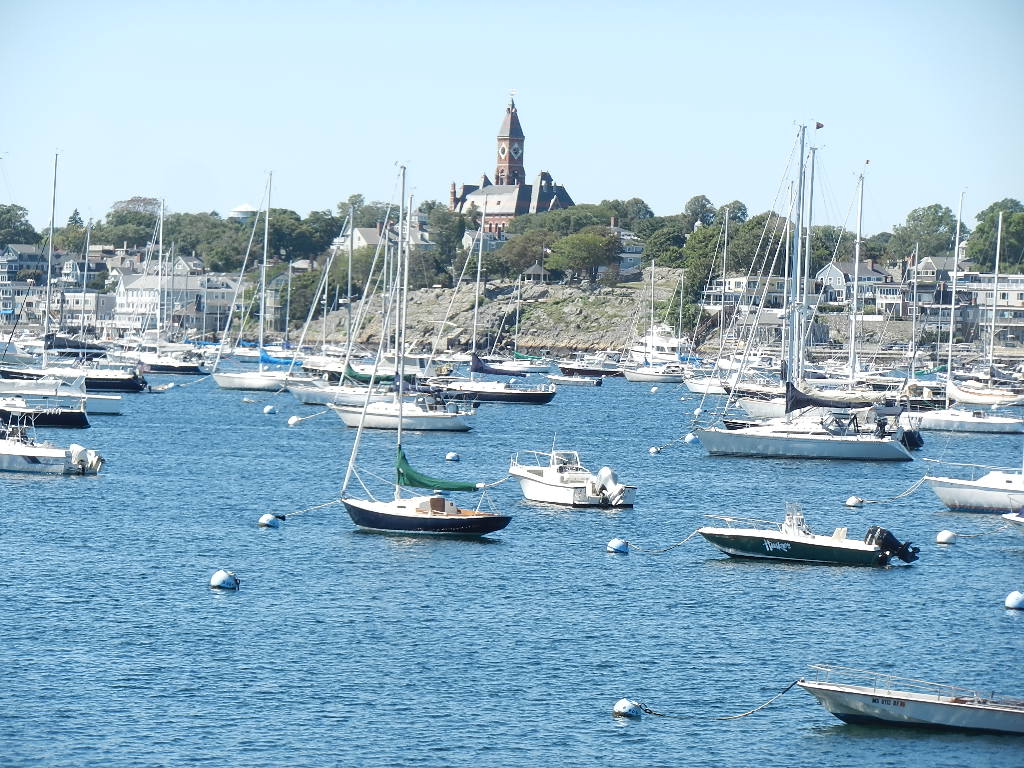
One on the highlights of our Marblehead adventure was visiting Abbot Hall. Abbot Hall, constructed in 1876, was a bequest from Benjamin Abbot who died in Boston in 1872. Abbot stipulated that the building could used for any purpose as determined by the town fathers. Today it serves as the town hall and a historical museum. As shown in the photo below, it is a prominent landmark.


Abbot Hall houses the original painting Spirit of '76 by American Archibal MacNeal Willard, which was widely reproduced. Of note, he used his father, Samuel Willard, as the model for the middle character of the painting.

Spirit of '76
Also at Abbot Hall:

Plaque commemorating the Hannah, the first ship in the US Navy
Scale model of an LST (Landing Ship Tank)
Encounter between the USS Constitution and the British frigate Guerriere
A decisive victory for the Constitution
Source of the nickname "Old Ironsides"

.We are in the room with the painting, The Spirit of 76" Notice the older man in the chair. He is the local historian. I did not get his name. He was chatting with a couple about Marblehead history and we joined the conversation. You can see Kodi listening intently to every word. So did we.

Note: I did not have to take notes. The town fathers published a 48 page book entitled "Celebrating Abbot Hall" containing an explanation of everything in the museum.

Now to the historical district.  

Map of the Marblehead Historical District
The town docks were right in the heart of the district, which made it easily accessible for us. The following is a quote from the Trust For Architectural Easements: "The colonial town has preserved its sense of time and place with picturesque streetscapes of densely-clustered Georgian houses with low-pitch gable or hip roofs, double interior chimneys, and pedimented entries with columns or pilasters. There are many commercial buildings too, such as the Old Town House, one of New England’s oldest, continuously used public buildings. But it is the concentration of Georgian architecture, which reflects the pre-Revolutionary War prosperity from fishing and commerce, that is most striking."

We agree. Walking through the historical district is like going back in time. In fact here's another excerpt that captures the mood of the district:

"It is said that the houses came first, and then the streets. This is certainly believable when one walks or drives through the old town. Houses face in many directions, front doors are not always in the front, and streets don’t always seem very well thought out. In early times people walked or rode on horseback, following dirt paths. When carts began to be used, the streets were made, working around large rocks, streams and ledge. They don’t seem logical now, but they did at the time."

House from 1718. See plaque below


Stock photo of historical homes
Ariel photo of the historical district.
A few more things about this wonderful city. Eating was great. We had dinner a Five Corners Kitchen, Cafe Italia Trattoria and Maddie's Sail Loft. All were excellent. Getting in an out of Marblehead, however, was a difficult. You have to drive through Salem and there is a two to three mile stretch that takes an hour to get through and there is no alternative route. The locals confirmed that "Yes, it's a bear every day, especially when school is in session."

Finally, I have to comment on the town dock's provision for dingies. Notice that it is low tide and how the dingies are secured. If you look close astern you will notice a heavy weight on a pulley. This arrangement allows the boats to maintain there position as the tide rises and falls. Very clever.


Written by Les.