Thursday, June 15, 2017

On the Hard Again: Getting It Straight - Background

This is going to be a long story.

The story starts in May of 2016 while en-route run from Sarasota to Hingham. During a routine engine check, I discovered black dust on the absorbent pad underneath the port side transmission coupling The pad was absolutely clean when we departed Sarasota.  This condition manifested itself after 1,421 NM and 200 hours of running since leaving Sarasota. My engines had just reached the 1,000 hour mark.

Port Coupling - Rubber dust on absorbent pad after 200 hours
 
Starboard coupling - no dust
Explanatory Note #1: My practice is to maintain clean absorbent pads underneath the engines and transmissions. This makes it very easy to spot a problem with the running gear, such as a fluid leak

According to Randy Ives, Outer Reef's Warranty Manager, the black rubber dust was coming from a bearing in the coupling and that eventually the coupling would need repair. He took the position that failure was not imminent and that I should address the problem when I came south in November.

Explanatory Note #2: According to Evolution Marine, the Evolution Flexible Shaft Coupling (EFSC) solves misalignment, absorbs and dampens shock loads and shaft vibrations, prolongs the life of machinery, and isolates metal-to-metal for quietness.

The EFSC is comprised of four major components: 1) a spool flange machined to bolt directly to the reduction flange; 2) a large circular rubber flex joint that's replaceable; 3) a split flange coupling for the shaft with pinch bolts, set bolts, and key-way; 4) a retainer cover that serves to protect the rubber flex joint, capture all bolts, and improve overall strength of the unit.

Meanwhile, at the completion of the May 2016 trip north, the Caterpillar C9 engines were ready for their 1,000 hour maintenance service. So, upon arrival in Hingham I put out quote requests to Milton Caterpillar and three other Cat AMDs (Authorized Marine Dealers). The 1,000 hour service involves, in addition to a normal oil/filter change, cleaning of the aftercoolers, heat exchangers, turbo chargers and a valve adjustment. This is a big deal (read as expensive - easily $10,000). Months go by an I get no response.

So I follow-up with the four perspective servicers. Milton Cat, the "big regional" Cat dealer was not interested in my project (and they will only work on engines - I have transmissions and generators that also need service - so I was really not interested in them). Two of the other Cat AMDs were too busy.  The third, Hansen Marine, took an interest in the project but they needed three tries to produce an estimate that closely reflected the 1,000 hour service tasks and required parts. They finally produced the "almost satisfactory" quote after I detailed the labor tasks and parts for them (using my Wheelhouse Technology Application).

Explanatory Note: Why, you ask, am I adamant that the servicer give me an estimate that lists all maintenance tasks and required parts? Simple. I want to ensure that the servicer can complete the job in one visit. I also want to shop for the best price. I do not think that is unreasonable.

Side Story: My son-in-law, Scott McBeth, runs a jet ski rental business at the Lighthouse Inn in West Dennis on Cape Cod. During his visit, which was just before my departure to Marblehead, he told me a story about getting ripped off on both parts and labor for a jet ski repair. Just for grins I decided to check Hansen's pricing on parts using my Wheelhouse Technology Maintenance Application. Oops. Hansen had overpriced about 15 parts to the tune of $600 as compared to Wheelhouse prices (which, by their own admission, are already marked up 10% over retail). So I bring the boat to Marblehead and the morning before starting the job, I bring the pricing "error" to Hansen's Service Manager's attention. Bad result. Tom calls back and says the owner, Bob Hansen, wont change the pricing. I get Bob on the phone and he gets defensive and belligerent (not to mention illogical about the reason for the overcharge). I don't like getting ripped off and Diana is shocked by Bob's reaction. We cancel the project.

Oops its September and I'm headed back to Florida on November 1 and I have no one to perform the 1,000 hour service. Back to the drawing boards. With a little help from Caterpillar I locate Guy Crudele, a Cat AMD located in Gloucester. Guy gets the parts and labor tasks right on the first quote and prices the parts at retail. Hallalujah!!!! Not only that, he completes the project on time and on budget. Hallalujah, Hallalujah!!!!

Meanwhile back to the Evolution Coupling Story. I made contact early on with Chris Murray at Soundown, the company that had acquired the Evolution Coupling business. After lengthy discussion, I decided to buy a new coupling ($2,700 - thank you) and have it installed when I returned to Florida. My logic for the new coupling was to swap out the "bad" one, have it rebuilt and keep it as a spare

So, upon arrival in Sarasota in November 2016, I immediately made arrangements to haul the boat and swap out the coupling. I chose Bayfront Yacht Yard, a division of Marina Jack, to address the coupling swap-out and bottom painting, which was definitely needed after three years.

Days before the scheduled haul-out a powerful northeast storm literally pushed the the water out of the ICW. Bayfront is located on Siesta Key and is accessed only from the ICW.  Bayfront, under normal circumstances, could only haul our boat at high tide and even then we would have only 6" of bottom clearance. Following the storm and for weeks thereafter (and in fact for the rest of the winter), Bayfront never saw even 5 feet at high tide (and even with a full moon). Good news, bad news. In this case they are both the same, We were unable to haul the boat, which turns out to be VERY GOOD NEWS as we would never have been able to launch it. In other words, Diana, Kodi and I would have been homeless for the winter.

Another Side Story: In anticipation of the haul-out, we rented a lovely 3 bedroom two bath home close to Siesta Key (and the boat) for 10 days using the HomeAway website. Unfortunately, we could not use it due to the water depths. So we lost $2,000. Again, good news. If the boat had stayed on the hard the financial loss would have been a $12,000 - $16,000 to rent a place for 4 months.

Back to the drawing boards. It took another two months to arrange a haul-out to address the coupling, bottom paint and other projects. This time I selected Embree Marine Services, a boat yard in St. Petersburg with a great reputation.


On Sunday, March 12, I cruised to the Harboridge Marina in St. Pertersburg with Phil Fuoco (a two time crew member - 2014) along with his wife Carol and two of their friends. It was a beautiful day for a cruise and we ended it with dinner at the St Petersburg Yacht Club.  The goal was to position the boat for an early Monday morning high tide haul out at Embree. After dinner, I drove my friends back to Sarasota and then drove back to St. Petersburg.

Approaching the channel that ends at Embree Marine Services
Early Monday morning, I pulled out of Harboridge and proceeded down a narrow channel to Embree. You can see by the photo of the Travelift that I arrived at high tide. Glitch. Due to the positioning of the boat on the Travelift (she was stern heavy), they needed to off load 300 gallons of fuel from the aft auxiliary tanks to enable them to lift the boat.


Arriving at Embree

The 63 was still in the water by the time we departed for Fort Lauderdale
Diana and I then took off for a two week "vacation" in Fort Lauderdale Florida. Our friends, Sophocles and Elena, generously gave us the use of their beautiful condominium with a spectacular 230 degree views that encompassed the city, the Atlantic and the ICW.

Jackson Towers, our home for two weeks
Houston, we have a problem. Ok, I admit that may be a bit more dramatic than necessary. On Friday morning, four days into the project I get a call from Chad Shakespeare, the Service Manager at Embree, informing me of a serious problem with the new coupling. It had a flange capable of receiving a 2.75 inch shaft. The shaft on the 63 is 2.5 inches. Oops.

I immediately informed Chris Murray at Soundown of the flange problem. Chris said "no problem," just have the yard remove the flange from the old coupling and install it on the new one. We did this and the project proceeded. Turns out it was not that simple.

Embree finished the projects on Thursday, March 22. Early Friday morning Diana and I drove 5 hours from Fort Lauderdale, stopped in Sarasota to pick up my friend, Jim Lampl, and drove to St. Petersburg arriving at around 12:00 PM. Jim and I departed at 2:00 PM after dealing with a few last minute issues. Our goal was to get back to Sarasota for a 7:00 PM dinner party with the Singers. We actually got there at 7;30 PM - lovely dinner party. OK, some days are a bit hectic.

Unfortunately, all was not well with the port engine running gear. Upon arrival at Sarasota I discovered that there was a leak at the shaft seal, which manifested itself on the clean absorbent pad that I had installed before leaving Embree.

I informed Chad that the shaft seal was leaking along with a couple of other minor issue. No problem says he and several days later, on April 10, his top technician, Randy Cornett, arrived at Marina Jack to address the issues. Randy had me "sea trial" the boat at the dock by putting the port engine in gear at idle speed. Sure enough, we saw water leaking at the seal and more importantly, perceptible motion at the power takeoff and shaft seal. Randy declared that the alignment was not successful. Randy and I contacted, discussed Randy's findings with Chad and we agreed on a date to haul the boat. BOY, DO I LIKE DEALING WITH PEOPLE WHO HAVE INTEGRITY!!

Now the project get's more complicated. Chris Murray from Soundown was not happy with the flange swap-out and felt it may be contributing to the misalignment. So, he had Embree ship the old coupler back to Soundown so it could be rebuilt and have a 2.5 inch flange installed. Due to the fact that I was departing on May 1 for Hingham, Soundown expedited the rebuild and shipped the coupling to Embree overnight (read as very expensive). Just for the record, the new coupling, the rebuild and the shipping came to $5,181. Ouch!

Note: Chris also agreed, as part of the deal, to rebuild the new (now old) coupling once it was removed. The plan was tag it and store is as a "spare."

Guided Discovery "On The Hard Again"
On Tuesday, April 25, accompanied by Phil Fuco, I cruised to St. Petersburg to haul the boat at Embree. Upon arrival, Embree off loaded 300 gallons of fuel from the auxiliary tanks to facilitate the lift. Chad's team went to work, hauled the boat, swapped out the coupling, installed a new lip seal and, working in conjunction with Chris Murray, re-did the alignment. I returned on Thursday, April 28th to take possession of the boat.

Reader's Note: The following paragraph appears in the article "Decisions, Decisions and Still More Decisions."

"The boat was hauled on Tuesday, April 25, at Embree Marine Services to correct an alignment problem on the port engine. On that haul, Embree had removed 300 gallons of fuel from the auxiliary tanks to facilitate the lift. On my instructions, they returned all 300 gallons to the main tanks, which topped them off, and put the excess (31 gallons) in the auxiliary tanks. Therefore, I left St Petersburg Florida on Thursday, April 28 with 1,000 gallons in the main tanks. Upon arrival in Sarasota I noted a fuel burn of 39 gallons. At departure on Monday morning I had 960 gallons in the mains (and 31 gallons in the auxiliaries)."

After the off-loaded fuel was pumped back into the tanks (see above), Chad, Randy and I took the 63 for a sea trial off the local waters. This version included running the boat through the full power curve to check for any vibration and to exert maximum stress on the running gear. Chad came up to the bridge with the bad news. The shaft seal was leaking and they could see perceptible motion at the power takeoff and seal. Chad took the helm and I went to see for myself.

As we headed for the city dock the three of us discussed the situation in relation to the upcoming 1500 NM cruise to Hingham. Chad explained that he had done his best and was now out of options (even if I agreed to delay the trip north). He agreed to refund the cost of the alignment $1,080. He did not think that the misaligned running gear posed a safety problem that would cause me not to make the trip north. That said, the 200 hour run north would probably damage the coupling. So the consequence was strictly financial.

Did I mention that I like doing business with people of integrity? Chad Shakespeare and Embree Marine are good people who stand behind their work. Most of their work was successful and where they failed they corrected the problem or refunded the charge. Hard to argue.

So, you ask, where is the pony in this pile of manure? By heading north back to Massachusetts I have the opportunity to work directly with Soundown, the manufacturer of the coupling and their engineer, Chris Murray. Soundown's headquarters is located in Salem Mass which is close to Gloucester where there are marinas with the ability to haul the 63.

Stay tuned for part two of the story.

Written by Les.


Wednesday, June 14, 2017

On The Hard Again: Getting Hauled Without Getting Hosed

As mentioned in the first "On the Hard Again" article, there are three major projects for this round of maintenance and repair:
  1. Normal maintenance of the engines, transmissions and generators
  2. Correction of an oil leak on the port engine that manifested itself on the trip north
  3. Alignment of the port engine's running gear.
The third, the alignment project, necessitated hauling the boat. This project is extremely complex as it involves a lot of moving parts (which is an interesting play on words as the running gear is mostly moving parts). The systems involved, working from the transmission backwards, include:
  • The Evolution Marine Coupling
  • The shaft
  • The Tides Marine Shaft Seal
  • The hull cutlass bearings 
  • The strut cutlass bearing
  • The propeller
Given that I had already made two tries over the winter to resolve the alignment problem, both of which were unsuccessful, I was determined to get it right this time. This involves a lot of players: 
  • A Caterpillar technician to deal with the engine maintenance and repairs
  • An expert on engine alignment
  • A propeller shop with the ability to work on shafts and cutlass bearings
  • Soundown, the company that built the coupling
  • A boat yard capable of hauling the boat. 
Believe me putting all of this together is fraught with challenges and ultimately required considerable time to assemble the right players.

So lets start with the haul-out. To haul the 63 you need a Marine Travelift with the capability of lifting 100,000 pounds. There is no boat yard within 40 nautical miles that has that capability. I either have to go south to Plymouth or north to Gloucester. I chose Gloucester as I have a relationship with the Guy Crudele, the Cat AMD that works out of there.

Explanatory Note: The 63 empty weighs 73,000 pounds. Add 9,100 pounds for diesel fuel (1,300 gallons at 7 pounds each). Add 2,400 pounds for water (300 gallons at 8 pound each). Add 3,000 pounds for our gear and stuff. Add 1,000 pounds for the tender. Fully loaded the 63 weighs 88,500 pounds. At a minimum, we need a 50 metric ton Travelift.

I called Cape Ann Marina and Rose Marine for quotes. I would classify Cape Ann Marina as a yacht yard and Rose Marine as a commercial yard catering to working boats. A yacht yard was, in my opinion is preferable to a commercial yard. Hence Cape Ann would be the preferred choice.

When I called these yards I asked the same question: "What is your per foot charge to haul the boat and have it on the hard for 4 days?"  Rose quoted $10.50 per foot with no charge for the first 5 days. Peter at Cape Ann quoted $10.00 per foot plus $1.00 per foot (or $63.00) for each day on the hard. Do the math. Rose wanted $662. Cape Ann wanted $630 for the haul and $252 for the time on the hard. Total: $882. Rose wins on price but only provides 110 volt 15 amp power via an extension cord. Cape Ann wins, theoretically, on yard cleanliness and the ability to connect our power cord power. I chose Cape Ann.

Explanatory Note: When you ask a marina for a per foot haul-out charge and tell them the boat will be on the hard for 4 days, you have a REASONABLE EXPECTATION that the per foot charge includes the haul out and the return of the boat to the water. Again, you have made it clear that the boat is going to be in the yard for 4 days. So, logically, it has to go back in the water. Since the boat is not going to hang on the lift, another reasonable expectation is that the boat will blocked and stabilized with jack stands. Finally, it is not unusual that the per foot charge includes power washing the hull (as the marine life if not removed immediately hardens into CEMENT). Here's an example. "Haul boat, pressure wash, block and launch  ($10 per foot)  plus $25.00 for pressure wash.

Back to the story.

I called Cape Ann and agreed on Monday, June 12 as the haul date. The owner, Drew Domenick, told me I needed to get my yacht insurer to name them as a named insured (which included the names of 7 entities) and sign some documents. Imagine my surprise when I received Cape Ann's contract and saw that $10.00 per foot was for the haul-out only. Returning the boat to the water was ANOTHER $10.00 per foot. Then I noticed that they wanted $7.00 a foot to power wash the hull (4442) and another $4.50 a foot to block to boat. Do the math. They wanted $31.50 a foot plus $252 for 4 days on the hard. Total: $2,217. UNBELIEVABLE!!!

So I called Rose Marine again, spoke to the owner and asked him for clarification. He confirmed that $10.50 per foot included the haul-out and return to the water. I then asked for the cost to power wash the hull. He said a minimum of $100 and not more than $200. Not unreasonable. I pay my diver $315 to scrub the hull in the water. Again do the math. Rose wanted $762 to $862.

There is a big difference between $2,217 and $862.

I call Cape Ann back and spoke to Drew Domenick. I pointed out that his representative had mislead me with regard to the charges. He gave me a song and dance that I should have looked at his website as the charges were clearly listed - which they were. However, as a gesture of "goodwill" he agreed to comp me one day on hard (yes a whopping $63). I thanked him profusely for his generosity and promptly signed up with Rose Marine.

I have a favorite saying about people who engage in sharp practices. So this is for you, Drew Domenick.  "You can cut a fat hog, but first you got to catch it."

Hope you enjoyed the story.

Written by Les.


On the Hard Again: Gloucester Cruise & Accommodations

The 63's need for maintenance and repairs has us in Gloucester again. The projects for this round fall into three categories:
  1. Normal maintenance of the engines, transmissions and generators
  2. Correction of an oil leak on the port engine that manifested itself on the trip north
  3. Alignment of the port engine's running gear.
The alignment of the port engine will be dealt with as a separate article titled "On the Hard Again: Dealing with Repair Challenges." This project is also the reason for the series title "On the Hard Again" as this particular repair cannot be done in the water,

This first article will deal with the fun stuff, the cruise from Hingham to Gloucester and the challenges we face as live-aboards when the boat goes on the hard.

Bottom line. We need to find a place to live while the boat is on the hard. Diana to the rescue. She undertook the task of finding a place for us to live. My role is to move the boat, clearly the fun part.

For this trip I decided to cruise to Gloucester single handed. That cruise started Monday morning with cast off help from Skip Roper, a former crew member (November 2015).  The weather was perfect, calm winds with a temperature in the low 80s at 8:15 AM.  The tide at departure was dead low, which exposed all the shallow water along the route out to open water. Fortunately, my route is well marked with lots of deep water.

At around 9:00 AM, I passed Nixes Mate (a tricky spot), turned north into President's Road, the main channel out of Boston Harbor and activated the route to Gloucester. The GPS showed my ETA at 11:50 AM. I called Rose Marine to report my ETA and was advised that their crew goes to lunch between 12:00 and 12:30 PM. This prompted me to throttle back to time my arrival when the crew returned.

Map of Gloucester Harbor
Rose Marine is across from the State Fish Pier
4 hours later, having averaged 7.3 Nautical Miles Per Hour from the dock, I arrived in the Gloucester area and headed down the channel to Rose Marine. Here's some of the scenery I passed.

Expensive waterfront homes to port as I approach Gloucester Harbor

The lighthouse at Ten Pound Island


Gloucester downtown area

Arriving at high tide

Passing historic buildings at Rocky Neck Park

Scenery on the way to Rose Marine

Rose Marine is located just after the dinner cruiser to port

Commercial fishing boats across from Rose Marine


Approaching Rose Marine at 12:20 PM, I passed the Beauport, a dinner cruiser docked just short of the Travel Lift, which is between the stern of the dinner cruiser and the blue fishing boat.

Boats on the hard at Rose Marine

Holding station at the lifting bay waiting for Rose Marine to move the fishing trawler

Oops. I picked up polypropylene lobster trap line on the port propeller
Good thing the boat was being hauled today

Power washing begins

View of the yard while the 63 is hanging on the Travel Lift

Guided Discovery waiting for transport into the yard and onto the hard

We had dessert at this lovely Rockport restaurant 

Rockport Harbor
Where to stay. Diana found us lovely accommodations at the Ocean House Hotel at Bass Rock. Below is the hotel's "pitch."

"Perched on the rocky shores of Cape Ann, just a short drive from Boston, the Ocean House Hotel at Bass Rocks is a historic landmark in scenic Gloucester. Originally constructed in 1899, and listed in the National Register of Historic Places, our hotel has welcomed guests for more than 100 years. Picture-perfect views of the Atlantic Ocean and rocky Cape Ann shoreline inspire you to unwind in comfortable rooms and suites with private patios and verandas. Enjoy complimentary seaside breakfast each morning and watch the sun set by the fire pit every evening. Take a dip in the heated outdoor pool or make use of our complimentary bikes and go exploring. Relax, unwind and play at our historic New England retreat at the edge of the ocean in Gloucester."

Ariel view of The Ocean House Hotel at Bass Rock Gloucester

The Ocean House Hotel at Bass Rock

Pool and rooms at the Ocean House 

Fire pit and ocean view from our room
Written by Les


.

Thursday, May 11, 2017

Streaming North: Cruising Off the Continental Shelf

Article started on Sunday, May 7, 2017 at 6:00 AM

Direct Hingham, MA from Georgetown SC

Overview:

The two day weather layover in Georgetown allowed a massive low pressure system to work its way north and east. As it did, widespread high pressure from the Midwest took its place. The forecasts for our proposed route at departure from Georgetown on Sunday at 6:30 AM indicated 15 to 20 knot winds, mostly out of the southwest and west, with following seas 3 to 5 feet from Georgetown all the way to Cape Hatteras, some 213 nautical miles to the east northeast. For the rest of the 600 nautical miles to Massachusetts, the forecast called for diminishing winds and seas around 2 feet.  

The deep low working its way north
We are now predicting arrival in Hingham at 6:00 AM on Thursday morning May 11th using existing programmed routes.  If the forecast holds, we will cover a record 813 nautical miles and, for the second time this voyage, run continuously for four days and three nights. This is truly exciting.

Underway:

We departed Georgetown’s Harborwalk Marina at 6:51 AM and headed 13 NMs south down Winyah Bay to the Atlantic Ocean. Our departure at close to slack tide put us in position for a favorable current.

At 8:44 AM we cleared the Winyah Bay Inlet with an average speed of 8.5 knots and, with full consideration for the forecasted winds and seas, programmed a 220 nautical mile route from that took us direct to Cape Hatteras via Cape Fear (Southport NC) and Cape Lookout (Beaufort NC).

Explanatory Note: This route requires rounding three shoals, Frying Pan at Southport, Cape Lookout at Beaufort and Diamond at Hatteras.  This route can be run close to the coast or offshore. Going close to shore significantly increases the distance traveled as the shoals associated with the capes protrude out many miles (11, 12 and 8 respectively). The near shore route is approximately 268 nautical miles as compared to 220 if run in a straight line.  Those 48 NMs translate into 6 additional hours of travel (and 55 gallons of fuel).

At 5:00 PM on Sunday we crossed the Frying Pan Shoal Slue, a marked shortcut through the shoal with at least 20 feet of water. We noted a following sea, a smooth ride and conditions favorable for continuing to Cape Hatteras offshore in a straight line.

We rounded Cape Lookout Shoals at 3:00 AM on Monday noting a following sea and west northwest winds of 18 to 22 knots and headed direct to Cape Hatteras some 68 nautical miles ahead. We had traveled 167 NMs since leaving Georgetown.

Here’s a question to ponder with regard to the name “Cape Lookout.” Did this cape get its name because it was a good place to “lookout” over the ocean or was the name trying to convey a message – “lookout!!!” The folks who named Cape Fear seemed to be very clear with their message – this is a bad spot. Of course the naming system breaks down at Cape Hatteras, which is without question the most dangerous spot on the Eastern Seaboard. If I were given the naming task I’d call it “Cape Hell,” which it has been on three of our north/south voyages.

Calm waters

Guy at the wheel

Good view of our pilot house instruments
At 11:03 AM on Monday Cape Hatteras was “Cape Easy” with north winds at 10 knots and 2 to 3 foot head seas. Our speed had also picked up slightly owing to the Gulf Stream and our distance off shore. We noted in the log that the head sea we were experience might be standing wave action resulting from the opposing forces of the north wind fighting the Gulf’s northerly flow. Fortunately, the low 10 knot wind velocity only resulted in slight pitching. A stronger wind would have resulted in more violent pitching. We think the lesson is stay out of the Gulf Stream in a northerly wind.

Current sea conditions as we make our decision to go direct Buzzards Bay

Current location of fronts and pressure as we are make our decision to go direct Buzzards Bay

Conditions 24 hours later. We have a weather window
Decision Time: Earlier this morning Bob, Guy and myself performed our morning weather review. The forecast noted in the overview (above) for 3 to 5 foot waves at Cape Hatteras with an improving trend to two footers both near shore and offshore as we progressed north was still valid.  The forecast for calm seas stretched several days.  We had a weather window. This resulted in yet another strategic route decision and another all-time first. We decided to head direct to Buzzards Bay Massachusetts from the tip of Diamond Shoal at Cape Hatteras North Carolina (429 NMs).  This route takes us 85 miles offshore when we are adjacent to New York Harbor. By taking this route we shave off 71 nautical miles and 90 gallons of fuel.


Bob and Guy 
The combined saving in distance, fuel and time from going in a straight line from Georgetown to Cape Hatteras and then to Buzzards Bay is 135 miles, 142 gallons and 16 hours.  The distance from Cape Hatteras to Buzzards Bay is 429 nautical miles.  At 8.4 knots we will cover the distance in approximately 51 hours.

Stow-away. A flying fish landed on the flybridge
At 2:45 PM on Monday we were abreast of Oregon Inlet (just north of Cape Hatteras) running 24 miles from shore. While on this segment the winds became light and variable for almost two hours and the seas calmed to a 2 to 3 foot swell. Time to estimate some arrival times. At that moment, the GPS indicated 396 NMs to the beginning of Buzzards Bay. 

Estimate to:
  • the entrance to Buzzards Bay: 3:00 PM on Wednesday
  • the south end  Cape Cod Canal: 5:00 PM on Wednesday
  • Hingham Shipyard Marina: 1:00 AM on Thursday.
We also noted that the current in the Cape Cod Canal will become favorable at 4:30 PM. It will be fun to see how these estimates play out.

Meanwhile, back to the voyage.

On Monday at 8:35 PM we were 76 NMs east southeast of Cape Henry (Virginia Beach) maintaining an average speed of 8.5 knots thanks to the Gulf Stream. Winds were east northeast at 10 knots. That gave us a 2 to 3 foot quartering head sea and a smooth ride. We were now outside the continental shelf in over 3,000 (three thousand) feet of water.

This photo shows we are outside of the Continental Shelf
As we progressed further north into the evening and early morning on Tuesday the winds and seas decreased to the point where we riding on a beautiful calm sea.  When I took 1 to 4 watch there was very little to do but enjoy the serenity of a moonlit night and listen to James Taylor. Most important, the marine forecasts for our route continued to predict optimum conditions.

Calm waters almost 100 nautical miles offshore
At 4:00 AM, when my watch ended, we were 106 NMs south southeast of Cape May New Jersey (at the north side of the Delaware Bay) and 100 NMs east of Cape Henry (at the south side of the entrance to the Chesapeake Bay) in placid waters with no traffic within 24 NMs (according to the radar).

Explanatory Note: Running almost 100 miles from shore and more than 100 miles from a navigable inlet and shelter of a marina or anchorage is serious business. One should not undertake such a voyage without a weather window that covers the enroute period and even beyond. A “surprise” change in the weather does not leave many options when your boat’s cruising speed is 8.4 knots and its top speed is 13 knots with a 50 GPH fuel burn. Heading for shore/shelter is an 8 hour 400 gallon proposition at top speed (assuming you have enough fuel). Bottom line. A trawler like the 63 cannot out-run the weather. The “good news” (sort of) is that the 63 is rated “Ocean A - Unlimited.” She can handle anything - but why.  The other consideration is mechanical reliability. Alongside of aggressive maintenance, we visit the engine room every 4 to 6 hours to verify the working of our machinery.

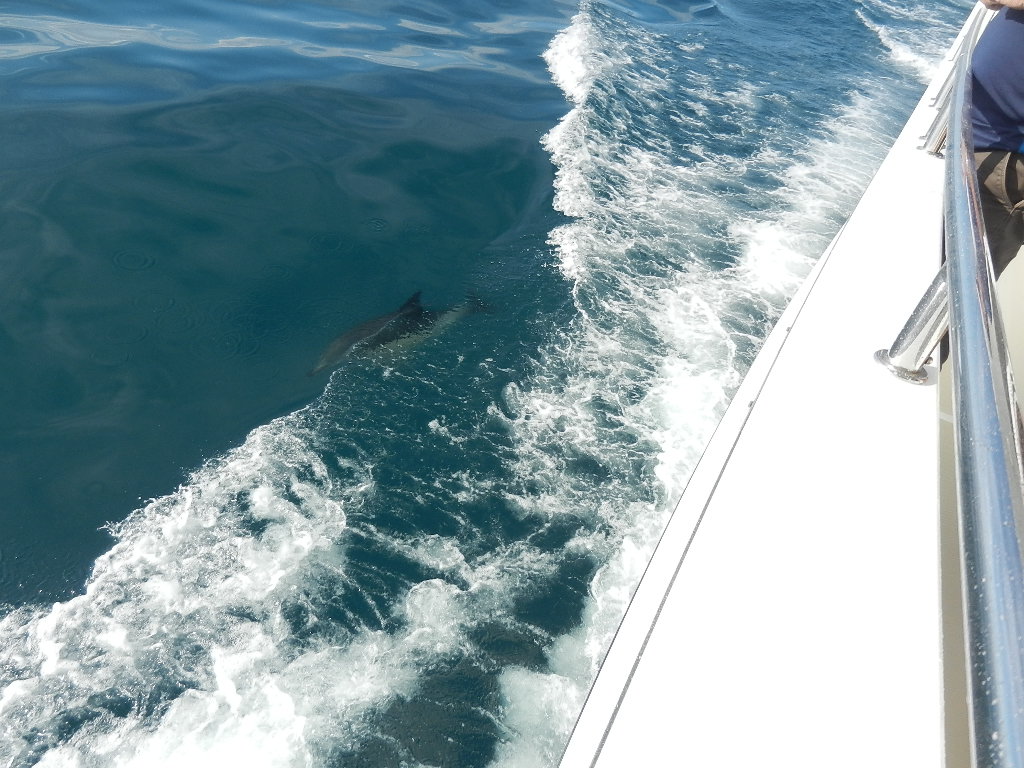
We had several visits from dolphins

Dolphin off the starboard side


Dolphins riding the bow wave
On Wednesday, May 10, 2017, when my 1 to 4 watch began, we were 90 NMs southeast of New York City and 119 NMs from the entrance to Buzzards Bay. Still way offshore in perfect conditions. Our ETA to Buzzards Bay was now 4:25 PM (Wednesday). When my watch ended at 4 AM it had improved further to 3:41 AM.

Earlier on Tuesday afternoon (15:10 log entry) our speed continued to decrease. We noted a current speed of 7.0 knots, a drop of 1.4 knots from our 8.4 average (which is also the 63s optimum cruise speed). Sirius’ water temperature chart (called “Fishing”) showed us in cold water off the continental shelf. We hypothesized that we were running against the Labrador Current that comes down from the North Atlantic and which causes the Gulf Stream to veer east northeast past Cape Hatteras. Whether that is true or not, it did not alter the fact that we would not achieve our 3:00 PM ETA to the beginning of Buzzards Bay or the favorable push through the Cape Cod Canal that begins at 4:30 PM.

This caused us to consider the impact of the speed decrease in relation to the current at Buzzards Bay and the Cape Cod Canal. Basically, we would reach Buzzards after the current began to flow south, which would result in an average 3.0 knot speed reduction over the 25 NMs to the east end of the Cape Cod Canal. We pondered an immediate increase to our speed. To counter the lost 1.4 knots we would have to increase RPMs to 1700 (9.9 knots). However, the fuel burn at 16 gallons an hour shot that idea down as it almost doubled fuel consumption. 24 hours are needed to cover the 194 NMs to reach Buzzards at 3:00 PM. This would result in an additional fuel burn of 216 gallons (over $500). We concluded that it did not make sense given our projected arrival in Hingham in the early morning hours and the fact that we were not up against a deadline. Further, we again hypothesized that our speed might just increase as we crossed over the Continental Shelf and returned to shallower water.

So back to 4:00 AM and the end of my watch. Our ETA was now 3:41 AM. Was our hypothesis correct? Who knows. But the result is the same. As of this moment, we traverse Buzzards Bay and the Cape Cod Canal on a favorable tide.

We made our first landfall in days when we visually spotted the wind farm off Block Island at 10:35 AM. It was 19 NMs west of our position.  At 12:30 PM we were adjacent to Block Island, 11 NMs to the northwest. Winds were west at 10 knots and seas were less than 2 feet.

Bob watching a pusher tow overtake Guided Discovery


As we approached Buzzards Bay we began seeing fishing buoys and lobster pots. We used these "obstacles" as an opportunity to practice spotting and dodging small objects with our FLIR night vision. Great fun - kind of like a video game.

At 3:51 PM on Wednesday we reached the the entrance to Buzzards Bay and the beginning of the home stretch.  Best of all we arrived just as the tide turned to a northerly flow giving us an increase in speed.

Tide Turning Positive just as we enter Buzzards Bay 

By 6:40 we had reached the Hogs Island Channel, which marks the beginning of the Cape Cod Canal. We saw a 4 knot increase in speed to 12.5 knots and a top speed of 13.5. Note: The 63 can barely reach 13 knots and when it does it is burning 50 gallons an hour. The current was pushing us at our top speed while are fuel burn remained 9.1 GPH. Life is good.

Railroad lift bridge at south end of the Cape Cod Canal

12.8 knots current speed and 13.4 top speed in the Cape Cod Canal

3.2 knot current at the Sagamore Bridge
Current moving toward 92 degrees (a northerly flow)
The Sagamore Bridge as viewed on FLIR night vision
At the east end of the Cape Cod Canal we turned north and headed for Hingham. Five and a half hours later at 1:00 AM on Thursday, Guided Discovery was sitting at the dock. We had hit the arrival time that we predicted three days earlier to the minute.

Heading north from the east end of the Cape Cod Canal to Hingham
Moon rising over Cape Cod Bay 
This amazing voyage was over but, clearly, it was one for the record books. 

Segment Statistics:
  • Total Segment Distance: 745 NMs
  • Average Speed: 8.4 Knots
  • Top Speed: 13.5 Knots        
  • Engine Hours: 91
  • Engine Fuel Consumed: 872 gallons
  • Fuel Efficiency: .85 GPNM
  • Generator Fuel Consumed: 93 Gallons
  • Total Fuel Consumed: 964 Gallons
  • Fuel Remaining: 336 Gallons (186 usable based on a 10% reserve)
Trip Totals
  • Total Distance: 1,513 NMs     
  • Engine Hours: 174
  • Engine Fuel Consumed: 1,667 Gallons
  • Overall Engine Fuel Efficiency: .91 GPNM
  • Generator Fuel Consumed: 211 Gallons
  • Total Fuel Consumed: 1,878 Gallons
Written by Les.