Saturday, May 6, 2017

Streaming North: Decisions, Decisions and Still More Decisions

Welcome back.

To fully appreciate what is going to happen over the next 3 days you need some background information. 

The boat was hauled on Tuesday, April 25, at Embree Marine Services to correct an alignment problem on the port engine. On that haul, Embree had removed 300 gallons of fuel from the auxiliary tanks to facilitate the lift. On my instructions, they returned all 300 gallons to the main tanks, which topped them off, and put the excess (31 gallons) in the auxiliary tanks. Therefore, I left St Petersburg Florida on Thursday, April 28 with 1,000 gallons in the main tanks. Upon arrival in Sarasota I noted a fuel burn of 39 gallons. At departure on Monday morning I had 960 gallons in the mains (and 31 gallons in the auxiliaries).

Guided Discovery on the hard at Embree Marine Services


The original plan was to fill up in Miami at the Miami Beach Marina, which is conveniently located just inside the Miami Inlet and then head back out and catch the Gulf Stream, which comes within 7 to 10 miles of the Miami Inlet. Then, weather permitting (defined as a southerly winds with favorable seas, preferably following) continue north riding the Gulf Stream to Cape Hatteras and then once past the cape, head north to Ocean City Maryland where we would refuel before the final leg to Hingham. If this all came to pass we would be in Hingham in a record 7 days. Note: The run from Miami to Ocean City is 818 nautical miles.

Now for the story.

Just south of Sand Key. Miami is 19,9 nautical miles north
At around 4:23 PM we off Sands Key and approximately 16 NM south of Miami. Our plan to stop for fuel at the Miami Beach Marina was not going to work as they close the fuel dock promptly at 6:00 PM. We would arrive at the open water buoy at 6:23 PM. So much for Miami fueling.

20 nautical miles south of Miami
We had covered 270 nautical miles, 243 NM since Venice
Current speed is 10 knots. Average speed is 8.1 knots (since Venice)
Decision Time: As we passed Miami around 6:30 PM we considered refueling at Port Canaveral early Wednesday morning and set up a route that kept us in the stream for as long as possible before heading northwest to the inlet. That plan was abandoned at 3:10 AM on Wednesday morning.

On Tuesday evening at around 8:30 PM we were off Fort Lauderdale. Looking to the northwest we could see dark clouds. Sirius Satellite Weather was showing a large area of thunderstorms with various intensities, including some bright red cells. The system was slow moving to the south with a slight easterly component.

Rain and thunder storms ahead
Coincidentally, Diana and Kodi were in Fort Lauderdale staying at our friend’s lovely condo on the beach. Had it still been light, Diana could have spotted Guided Discovery with binoculars. I talked with Diana by cell phone and we discussed the storms. Diana was concerned as NOAA had issued a tornado warning and urged me to seek shelter.

Explanatory Note: The risk of thunderstorms include high winds and lightning. High winds are likely with a frontal passage and are more severe when they form a squall line. Lightening is not a life risk when we are in the cabin. However, a lightning strike can take out the boat’s electronics and electrical system and can even damage the engine’s ECUs.  At an electronics seminar at an Outer Reef rendezvous in 2013 (while the 63 was being built) I asked the moderator about the current state of lightning protection for boats. He responded by saying that no solution had been developed and that replacement of burned out electronics was a substantial part of their business. A lightning strike can occur at sea and at the dock. There was no advantage to heading for shore.

Around 9:00 PM off Boca Raton we experienced the frontal passage with rain showers, thunder and occasional cloud to cloud lightning. Winds quickly increased from 3 knots to 24 knots and clocked from southeast to northwest. We noted a drop in current speed from 11.4 to 10.4. However, we were still solidly in the Gulf Stream. Our average speed was now 8.5 knots.

The cold front that was kicking up the storms
Decision Time. At 3.10 AM on Wednesday, Bob and I (Guy was sleeping) decided to bypass Port Canaveral and continue riding the Gulf Stream north to St Simons Georgia, some 200 NM north. Current speed was now 12.5 knots and our average has increased to 9.0 knots. We ball-parked our ETA at Morningstar Marina to be around 3:00 AM the following morning. Morningstar has 1,100 feet of transient face dock so the likelihood of finding space would be good.

Route to St Simons Georgia
The leg from WP 1492 to WP 1497 is the west wall of the Gulf Stream
Here’s the logic. We would continue to take advantage of the Gulf Stream and some reasonably good weather following the frontal passage (see below). Fuel reserve 300 gallons, 150 in each tank.

The forecast for Altamaha Sound to Fernandina Beach out to 60 miles:
  • Wednesday: Winds NNE 5 to 10 increasing to east 10 to 15 in the afternoon. Seas 3 to 4 feet with an 8 second period.
  • Wednesday Night:  East southeast winds (a quartering tail wind) 10 to 15 knots with 3 to 4 foot seas with a period of 8 seconds
  • Thursday: South southeast winds 20 to 25 knots with seas 4 to 6 feet.

At 4:00 AM on Wednesday we were 18 NM due east of Fort Pierce Inlet in 2 to 3 foot seas following the frontal passage. Our average speed was now 9.0 knots. We estimated current speed at 12.4 knots.

Passing the Fort Pierce Inlet. GPS Speed = current speed
12 hours later, at 4:30 PM, we were 58 NM east of St Augustine, Florida. Seas continued at 2 to 3 feet and our average speed had reached 9.7 knots. We had covered 550 nautical miles since leaving Sarasota.

Notice that as we continued north our off shore distance increased dramatically. That’s the reality of running the Gulf Stream. To stay in the stream you have to be willing to cruise way offshore. It would now take around 7 hours to reach shore and even more to reach a port. Favorable weather and well maintained boat are essential.

Decision Time: Earlier at 3:30 PM, Bob and I (Guy was again sleeping) decided to continue to Charleston, South Carolina. This was an easy decision. Why arrive in St Simons at 3:00 AM and waste time and good weather waiting for the fuel dock to open? Interestingly, this decision only added 60 nautical miles to the trip. Most important, it allowed us to continue in the Gulf Stream as Charleston was a straight shot 170 NMs north from our present position east of St Augustine Inlet. At that time we calculated 536 nautical miles made good. Charleston added 170 nautical miles for a total of 706 NMs. We calculated our reserve at 294 gallons. Readers with a sharp eye will notice that the fuel reserve to St Simons (300 NM) is identical for Charleston. How can that be? It’s simply a matter of heading due north instead of heading northwest (i.e., swinging the course arc). We would also conserved fuel by staying in the stream.

Decision to go direct o Charleston
At 1:00 AM on Thursday Morning we were 68 NMs due east of Little St Simons Island and mostly out of the Gulf Stream as indicated by current speed of 8.6 knots. We still showed an average speed of 9.7 knots.  Seas were running 2 feet or less as winds continued to back to the south. At that point we were 74 nautical miles south of Charleston with an ETA of 9:46 AM at the point where we would intersect with the Charleston approach buoys. We calculated our fuel reserve at 236 gallons including generator usage to the intersection.

The following words appear in the log for this latest entry. “Peaceful!!” BUT this is the “lull before the storm.” Read on. It clearly gets more exciting.

Written by Les.,

Streaming North: Discovering the Gulf Stream

Departure: May 1, 2017 @ 6:32 AM.

Following tradition, Darrel and Sue Peters joined us in the morning and helped us cast off. We met them in Florence Alabama in November of 2010 while on a Great Loop side trip. Sue left her pocketbook in the courtesy car and, having found no money in here purse (just kidding), we guessed that it was the folks on the 50 foot Ocean Alexander, returned the pocket book and have been friends ever since.

Back to business.

The Crew: Guy Aries, Les and Bob Benson
Departure from Sarasota is always a challenge as there is no easy way out to the Gulf. There are three options; Big Pass, New Pass and the Venice Inlet via the ICW, and each has its issues. Big Pass is a local knowledge pass that is tricky in calm water and dangerous with rough seas due to the shallow depths. New Pass, recently dredged, has a bridge with restricted openings before 7:00 AM and a very shallow channel leading from Sarasota Bay (where we almost touched last March) leading to the pass. Taking the ICW to Venice involves 4 bridges, two of which open every 20 minutes and numerous no wake zones.


Casey Key Swing Bridge
We chose Venice via the ICW on Monday morning as a brisk 20 knot wind out of the south was making 3 foot waves according to the forecast. That wave direction increased the risk of bouncing of the bottom at Big Pass. To shorten our time on this route we left at 6:30 AM to take advantage of the fact that the Siesta Key bridge opens on demand before 7:00 AM. The run to the inlet took two hours and 13 minutes.

When we entered the Gulf at Venice we saw that we had made the right decision as we immediately started pitching in a 3 to 4 foot head sea. Seas calmed to 2 to 3 feet as we passes Marco Island around 7:00 PM then increased to 4 to 6 as we progress toward the Keys. The 63 handled the seas well but pitching is not fun unless you’re playing baseball.

Around 4:00 AM on Tuesday morning we were 17 NM north of Marathon and the Seven Mile Bridge. Winds that had been 25 to 30 knots out of southeast winds reduced to 15 to 20 knots and the seas calmed.  At 6:27 AM, 24 hours after departing Sarasota, we crossed under the Seven Mile Bridge. We had covered 182 nautical miles at an average speed of 7.7 knots.

Seven Mile Bridge
Explanatory Note: The 63 cruises at 8.4 knots at 1400 RPM. The head winds and seas had reduced our speed by .7 knots. That may sound trivial but it’s not when you running 24 hours a day for multiple days. Essentially, you lose 16 NM and 2 hours every 24 hours.

Decision time. Run the Hawk Channel in protected water or run outside the reef in deep water to catch the Gulf Stream. This proved to be an easy decision as the forecast of south southeast winds at 10 to 15 knots with 3 to 5 foot seas was the same on both sides of the reef.

Would we get the promised push from the Gulf Stream? That question was clearly answered 4 hours later when we recorded an average speed of 7.9 knots. We were now seeing current speed readings of approximately 8.8 knots and, best of all, we were running in 3 to 4 foot seas off the starboard forward quarter. Those seas continued to calm (to 2 feet) and our speed continued to increase to 9.0 knots. The Gulf Stream was giving us a 1.5 knot push.

The depth increases as we cross the reef. Our position is shown on the right hand screen
Sorry for the poor photo 
The Gulf Stream turned Guided Discovery into a speedboat.  OK, I know. You think that’s a big exaggeration but you need to read on.

Written by Les

Streaming North: Results of a Lovely Winter

Hello readers!  It’s been a lovely and quiet Sarasota winter and I’ve been lazy about writing. However, now that I’m moving Guided Discovery north I am motivated to document our trip.

Explanatory Note: I write about the north south passages for two reasons. The first is to preserve my memory of what has proved to be some very exciting adventures. The second is to share the adventure with those of you who follow my blog. So here we go again.

Departure from Sarasota, by tradition, is May first at 7:00 AM. That tradition has practical roots dating back to the purchase of the 63. The goal was manage dockage costs, which no longer applies as we have an annual contract for our great slip at Marina Jack.  The original plan was to time our arrival at Hingham Shipyard for early May to enjoy a late New England spring and to get the maximum benefit of the marina’s 6 month seasonal contract, which ends October 31. Hence the November 1 at 7:00 AM departure from Hingham and the May 1 Departure from Sarasota.

The three other factors that affect the “tradition” are insurance considerations related to the hurricane season and the fact that Diana and Kodi move the car while I move the boat with friends, some of whom fly from wherever to crew on the journey. A date certain is a practical consideration for making airplane reservations. The third factor is weather. It starts to get hot in Sarasota and by late April we start seeing temperatures in the 90s (not great for us or Kodi’s paws).

The 7:00 AM departure is also motivated by my goal to minimize the time spent on the Okeechobee Waterway. It facilitates the crossing with two overnight stays by positioning the 63 for a 7:00 am opening at the first of Okeechobee’s five locks. With a little luck and a few speed adjustments it is possible to be on the Atlantic Ocean the morning of the third day. Then its 7 days and 6 nights to Hingham.

Did I mention the lovely winter? Well it was.  Sunny and warm every day with almost no rain (perhaps 5 days and then only showers). This threw a wrench in the works. At the end of the first week in April, I checked Lake Okeechobee water levels, which were 12.4 feet. Two weeks later the lake’s depth was 11.78 feet. The Army Corp of Engineers posted a controlling depth (i.e., depth at the lowest point on the waterway) as 5.72 feet. Do the math (.72 times 12 = 8 inches). Guided Discovery draws 5 feet of water at the keel. That results in a margin of just 8 inches between floating and “the hard,” which is rock in the low spots.

Time for local knowledge. A conversation with Bill at Lake Tow and Recovery, the local marine towing service out of Clewiston FL, was helpful.  Bill said it’s doable BUT you have to stay in the middle of the channel coming out of Clewiston and have calm winds. According to Bill, a moderate wind from the any southerly direction blows the water north and can lower the depth by 6 inches (oops, now we have a two inch margin). Having to pass another boat can result in a grounding as the depth deceases at the edge of the channel. Too close for me.

Note: As of May 4, the lake was at 11.65 feet with a controlling depth of 5.59 feet.

Plan B is a trip south along Florida’s west coast, a passage through the 7 Mile Bridge at Marathon, then east along the Keys via the Hawk Channel to Miami and then the Atlantic to Stuart. This route adds 170 nautical miles to the trip along with a fuel burn of approximately 190 gallons (at current fuel price of $2.70 per gallon).

The question here is which of three routes to take. There is the very shallow Intracoastal that runs inside the keys, which is not an option for the 63. Then there is the well-marked Hawk Channel with an average depth of 20 feet that runs between the Keys and the reef to Miami. We used this route in 2011 during our Great Loop adventure. The third option, weather permitting, is to run outside the reef in deep water (400+ feet) and pick-up the Gulf Stream. According to my friend, Captain Billy Thomas on the yacht Determination (a Westport 112), you can pick up at least one knot of speed.

In anticipation, I programmed two routes, one for the Hawk Channel and one for the outside route.

Outer Reef’s slogan is “Go beyond the reef.” Well, weather permitting I planned to do just that and more. The title of this series, “Streaming North” represents my intent to go way beyond the reef (like 60 to 70 miles offshore) and ride the Gulf Stream north. Read on to share a spectacular experience.

Written by Les.

Streaming North: Getting Ready with Twists

May 7, 2017

Owing to my writing laziness, this article, which deals with preparation, was written as we were underway in calm waters between Georgetown and Frying Pan Shoal at Cape Fear. This followed a two day weather layover in Georgetown to allow a massive low pressure system to work its way north. Forecasted weather for the next four days is for seas around 2 feet and we are predicting arrival in Hingham at 6:00 AM on Thursday. Plenty of time to write.

Moving a 63 foot motor yacht some 1430 or 1,600 nautical miles, depending on whether we cut across or go around Florida involves some, albeit easy, preparation. However, that was not exactly the case this for this trip.

The first consideration is crew. The original plan was to follow the usual route across the Okeechobee Waterway and then north up the east coast with a two hour stop in Morehead City for fuel. This year I invited Bob Benson, a fellow yachtsman and Hingham I-dock slip mate, to accompany me.  Bob owns ParadoX, a 2015 45 foot X-Type sloop, and is a very experienced sailor with considerable offshore time. Bob has run the 600 nautical mile Marion Massachusetts to Bermuda Race and cruised the east coast from Annapolis. My plan was to do the trip with myself and Bob.  Owing to the Glendenning remote, which allows me to control the boat from several positions, I reasoned that the two of us could easily handle the five Okeechobee Locks.

Then former two-time crew member Phil Fuoco (Norfolk to Hingham May 2014 and Hingham to Sarasota November 2014) expressed interest in joining us for the northerly voyage. Phil, however, is a bit more conservative then myself with regard to weather and distance offshore. In fact he thinks I’m a bit of a risk taker and to that I plead guilty (especially appropriate as he was an attorney) although the risks I take are very calculated. My contemplation of a 70 mile offshore run to catch the Gulf Stream eliminated Phil. Plan B. I invited Phil and his wife, Carol, to accompany us through the Okeechobee. First it would be a pleasant trip in calm waters, second it would make the locks a slam dunk and, finally, I could drop them off a Sunset Bay Marina in Stuart by going about 100 yards off my route. Phil and Carol signed on.

Lake Okeechobee water levels eliminated Plan B. There was at least 1.5 feet of draft clearance when I proposed the Okeechobee voyage. Four days from departure that level had dropped to 8 inches. I’m not that big of a risk taker.

A week or so before the May 1 departure date, Captain Guy Aries, another two-timer (Hingham to Sarasota 2015 & 2016) called me up and offered to join the crew. Why not? Three doing watches is better than two and Guy is a terrific crew member. His curiosity about navigation has led me to better understand my electronics as we dug through the manuals to understand my system’s capabilities. This proved again to be true of this voyage when I stated that it would be nice to have graph data showing wind direction over time. Guy found it and more on my 7215s.

So now it’s Bob Benson and Guy Aries for the trip north.

The next consideration is equipment reliability from the keel up. Running continuously day and night for multiple days, operating as much as 70 miles offshore and dealing with difficult weather conditions requires that the boat’s systems be in perfect working order. With the help of Wheelhouse Technologies’ maintenance software and my “punch” list, I’m able to keep Guided Discovery “shipshape and Bristol.”

That said, she was not without problems. The most difficult is the coupling on the port transmission that was shedding rubber, an indication that it was slowly going to failure. This has been an issue for two north/south voyages and I have been in ongoing communication with the manufacturer, Soundown, regarding the cause of the problem and when it might fail.  The engineer suspected an alignment problem. So, last October I purchased a spare coupling for $2,700 and stored it securely in the lazarette.

The other problem was bottom paint. After three years my Hingham and Sarasota divers were reporting that the paint had reached the end of its useful life (i.e., the copper was no longer preventing marine growth). Time to haul the boat and repaint the bottom.

With the boat out of the water we could check the propellers, check the cutlass bearings, check the alignment, service the shaft seals and replace the coupler. Embree Marine Services performed these tasks and, unfortunately, the alignment was unsuccessful. Hence, between April 25 and April 27 the 63 was on the hard, again, to correct the alignment issue. Again unsuccessful. However, alignment does not pose an immediate safety issue. I plan to address the problem this summer.

The next issue involves Diana, Kodi and the car. In a normal year (we’ve had three) Diana and Kodi run the car up the coast while I move the boat. Diana’s run takes 3 to 4 days as compared to my nine. Hence, Diana usually stays with our friends in Sarasota, the Singers, for three or four days before heading north.

Not this year. We discovered a nodule on Kodi’s butt in January and consulted with our vet. He was not concerned, prescribed an antibiotic and rechecked her a week later. The advice was to watch it. Then three weeks before departure we saw a spot of blood on a runner. Back to the vet. The vet was still not overly concerned but suggested removal and biopsy of the nodule.

A week later the vet called back. He was not 100% happy. The biopsy revealed a low grade mass cell cancer that, while not life threatening, bared watching. What was most troubling was his statement that had he suspected cancer he would have removed more tissue at the margin.

Time for a second opinion. This time from Southeastern Guide Dogs (SEDG) where Kodi is an ambassador. SEDG operates a state of the art veterinary clinic and has a top notch medical team led by Dr. Kevin Conrad. Dr. Conrad looked at the biopsy and said I agree with your vet that he should have removed more of the tissue and recommended we do it now. So 4 days before departure Kodi had a second surgery during which Dr. Conrad removed three other growths and sent them along for analysis.

So as I write this article, Diana and Kodi are in Fort Lauderdale staying with Sophocles Karapas at their condo. Boy, it is nice to have good friends. This year I plan to fly back to Florida and drive back with Diana. We may head to the west coast for a visit with Dr. Conrad at Southeastern.

UPDATE: Kodi's biopsy report revealed a clean margin, suggesting that the tissue Dr. Conrad removed got all of the cancer. Further, the other growths we benign. Good news.

Now for the easy stuff. Provisioning is a snap owing to the fact that I have the shopping list on an Excel spread sheet along with Morton’s “Gourment Meals to Go” and a little help from Fernando, their executive chef.  For this voyage, Chef Fernando graciously prepared three new dishes that I proposed based on Morton’s gourmet prepared foods. So we will eat well.

Written by Les.

Happy 3rd Anniversary - Finally Completed

Reader's Note:  I started this article over 3 months ago. I finally finished it.

May 26, 2017 (on my 74th birthday)

On February 10, 2014 at around 5:00 PM, Diana and I officially became the proud owners of OR63063, the 63 foot Outer Reef Long Rang Motor Yacht that we had contracted to build 14 months earlier. Now, as she sat in our Sarasota "winter" slip, we were celebrating our third year of living aboard this magnificent yacht.

Guided Discovery at Marina Bay Marina on the day we moved aboard
Three years of living aboard and six trips up and down the east coast have proven the 63 to be a comfortable place to live and an amazingly sea worthy vessel. It's also proven that the builder, Outer Reef, provides an ownership experience that can only be described as world class.

Sea worthiness:

In an email to ABT TRAC that sung the praises of their stabilizers, especially in heavy seas, I proposed that ABT, like Outer Reef, could make use of my experience as marketing material. I provided them with the following list of blog articles that chronicled our "high seas adventures."

Pilot house navigation system showing Sirus Satellite Weather on all thee screens
L to R: Precipitation, Forecast (highs, lows, fronts) & Sea Conditions (wave heights & direction, wind speed & direction)
Nov 2016: Sarasota Bound: The Fat Lady Screams (10 to 12s off Cape Hatteras)
May 2016: Hingham Bound: Spoke Too Soon (10 to 12s following seas off Cape Fear)
Nov 2015: Snowbirds Fall Migration: Weather Surprise (10 foot head seas off New Jersey)
May 2015: Onward to Hingham: Dealing with Tropical Storm Anna (10 to 12s off the starboard bow at Cape Hatteras)
Nov 2014: Crossing Cape Hatteras in a Raging Storm (7 to 9 foot seas off every point of sail)

I don't go looking for high seas adventure. However, I've been accused, including as recently as yesterday, of being a bit of a risk taker. To this I must plead guilty with mitigating circumstances (i.e., previous experience with the boat in heavy seas). There is no question that in May of 2015  when confronting the prospect of sitting for 8 or more days waiting for the very slow moving tropical Storm Anna to leave the Caribbean and move north, I chose to round Cape Hatteras with a forecast of 6 to 8's. Oops. Turned out they were 10 to 12s and we had them for almost 12 hours. The Outer Reef performed flawlessly.

Living Aboard:

We moved aboard three years ago. At the time we had a lovely town home in Chicago's beautiful Lincoln Park. By early summer we faced the reality that since leaving Chicago on October 3, 2010 to do the Great Loop that we had only used the town home for a total of 9 months over four years. Further, we were enjoying life on the 63. This prompted our decision to sell the Chicago property, which thanks to Diana's hard work was accomplished in less that 60 days. By September of 2014 we were living aboard full time.

What's it like to live aboard a Outer Reef 63 foot motor yacht full time? I answered this question two years ago in an April 2015 article entitled "Living on a 63 Outer Reef." This extremely detailed article describes every space on the boat and how it is used.

We have approximately 700 square feet of living space, 400 on the main deck and 300 down below. Add to that the outdoor space, 150 feet on aft deck and the 450 feet on the flybridge and boat deck.

Essentially we have a living room that comfortably seats 8 people, a full kitchen with every appliance found in a luxury home, a pilot house that serves as an office or eating area, a master bedroom with a king size bed, a bathroom, two closets and plenty of storage, a second bathroom and two additional bedrooms with even more storage. We even have the equivalent of a basement with even more storage organized as closets and secured containers.

The salon comfortable seats 8 people
We do not have a lot of stuff. During the process of selling our Chicago town home we divested ourselves of furniture, clothing and stuff by either giving it away or donating it. The donations amounted to approximately $50,000 at retail. I can barely remember what we gave away.

Master Stateroom
That said, we have everything we need including plenty of clothing. In my case, I could still give some away.  Most important, and this is one of the things I love about living on a boat, it's all perfectly organized and I know where everything is located (well almost everything)

Life style:

Essentially the 63 provides a comfortable home on the water with spectacular views. This is true in both Hingham and Sarasota.

In Hingham, at Hingham Shipyard Marina, we have the T-dock located at the west end of the marina. This affords spectacular views from every window. Astern, to the west, we view an uninterrupted 3/4 mile view of Back River. Forward from the pilot house we have a 3/4 mile view of the entrance to Hewitt's Cove. To port, we look at a condo development across the river in Weymouth and to starboard we have a view of the condos and restaurants at Hingham Shipyard.

You can see our T-dock in the photo (center right) 
Diagram showing Hingham Shipyard facilities
The marina's location at the Hingham Shipyard, affords access to 7 restaurants, three markets (Fresh Market, Trader Joes and Stop & Shop, retail stores including a bed Bath & Beyond and the ferry to Boston (35 minutes thank you).


In Sarasota, at Marina Jack, we have a view of Bayfront Park to the west and the city to the east. Most important, Marina Jack is located at the edge of downtown Sarasota with its restaurants, Whole Foods market, movie theaters (plural), opera house and theaters. Within walking distance is the Van Weazel performing arts center. Marina Jack, named the number one marina in 2015 by Marina Dock Age Magazine is a first class facility with three restaurants literally at the end of our dock.

Marina Jack surrounded by Bayfront Park and downtown Sarasota
And we have a car. Except for the fact that we live in a marina, we have a pretty normal life in both places. But that also deserves a comment. Living in a marina places us in a community of people with similar interests. We know almost everyone on our dock in both Hingham and Sarasota.

Did I mention that we have great weather all year round. Hingham gives us a late spring, summer and early fall. Sarasota provides 70 to 80 degree days November through March.

Outer Reef:

And finally, we come to Outer Reef, the builder of the 63. The relationship with Outer Reef has far exceeded my expectations, which were high from the beginning. Building a yacht is a big deal especially for first timers like us and doing it outside of the country (in Taiwan) just adds to the stress. That said, Jeff Druek, the owner of the company,  Mike Schlichtig, our broker and later Outer Reef's general manager, and Deborah Manzi, the head of design, guided us through the process and helped us make spectacularly good decisions about every aspect of the yacht. We have no regrets.

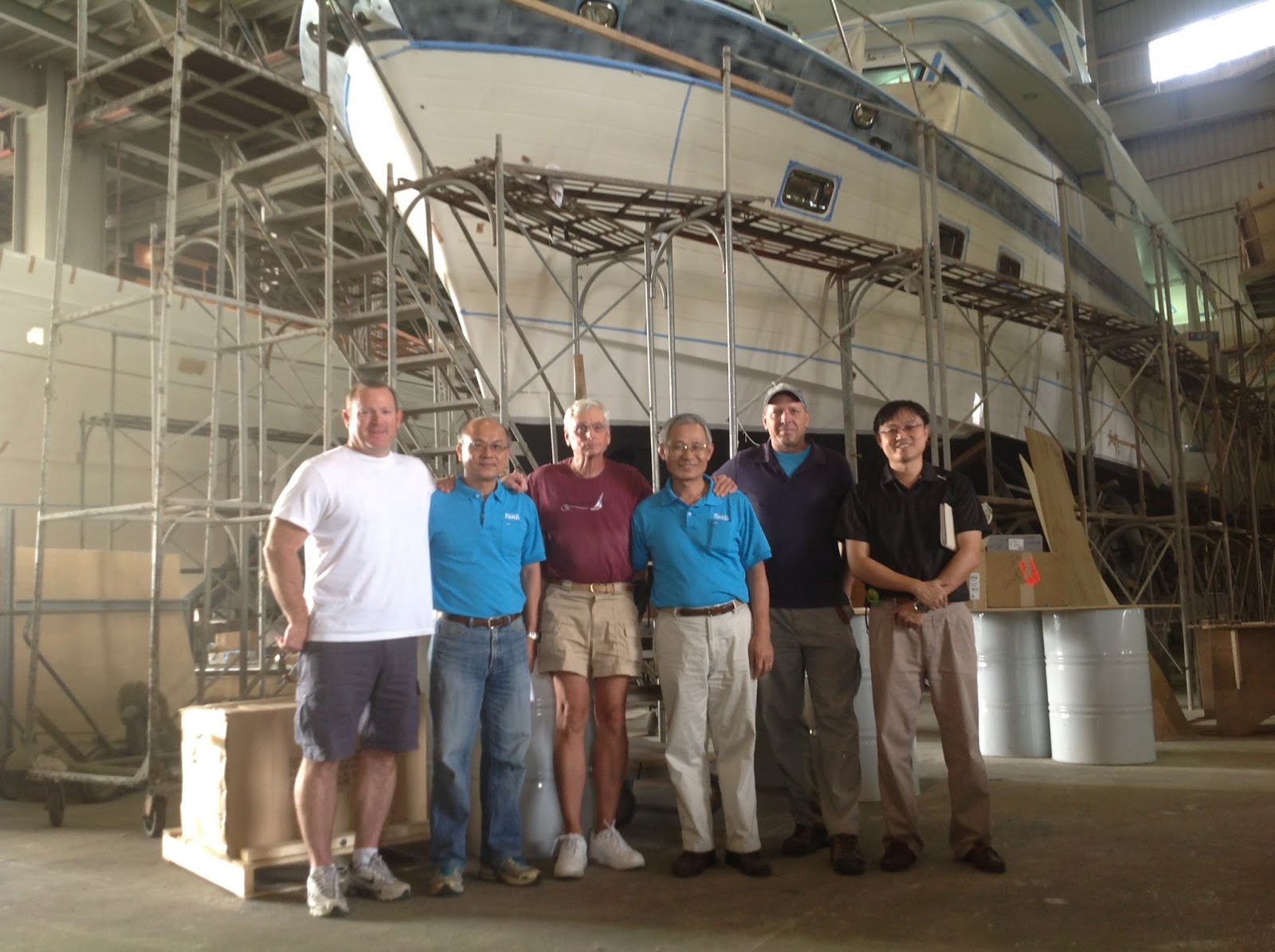
October 2013 - Mike and I visit Tania Yacht Company in Taiwan - Karl Lin and his management team 
Prior to entering into the building contract, I did my homework and talked to a number of Outer Reef owners. To a person they told the same story. They loved their boat, they felt they got more than they bargained for, they stated that Outer Reef had lived up to its warranty obligations and then stepped up to the plate by providing warranty coverage beyond the stated one year limit. Every statement that these owners made applies to us.

Most important, I have ongoing access to Captain Randy Ives, Outer Reef's Warranty Manager. In fact he's number 4 on my speed dial. Whenever I have a question, Randy is there to provide an answer. Randy spent days during commissioning training me on the boat's systems. I have pages of notes that I still use from time to time. To quote American Express, the relationship with Outer Reef is priceless.

Written by Les.

Tuesday, January 3, 2017

Groco HVAC Sea Strainer Adventures

Happy New Year!!!

What a way start the new year.  Talking about something as mundane as the monthly cleaning of the HVAC sea strainer.

The story I'm going to share is almost funny until you get into the details which involve the incompetence of the strainer manufacturer, Groco, and the inventory practices of West Marine, the nation's largest marine supply store chain.

Cleaning the HVAC sea strainer is a monthly task that usually takes 30 to 40 minutes. Today it took six and a half hours.

Groco SA 1500 Sea Strainer - note the basket inside and the center post
Explanatory Note: The 63's chilled water HVAC system either raises or lowers the temperature of sea water, currently 70 degrees at the marina, to either air condition or heat the boat. The sea water is pumped into the system through a sea strainer basket (see photo below) which filters out marine life. This system runs almost constantly.

Sea Strainer Basket. Note the hole in the base
The process is really simple. Shut down the HVAC system, close the through hull valve to stop the sea water flow, remove the top of the strainer housing, remove the basket, clean out the captured marine life, insert the cleaned basket in the strainer housing, open the valve to fill the strainer with water, tighten the wing nut on the strainer housing, check for leaks and your done.

Cleaning the basket is also simple. Dump the marine life and blast the screen with water to remove the stuff that is stuck to the sides.

So at 11:30 AM I started the process. As I removed the basket I discovered that the plastic base had separated from the stainless steel mesh. This is actually not a big problem since it can be reinserted and secured by bending the mesh into four slots on the plastic base. But it is an annoyance as it is a poor design.

As I was blasting the screen with water it flew out of my hand, sailed 30 feet through the air, landed in the water and promptly sank.  Oops, a simple task just got complicated.

Now I needed to source a new basket and that's where the frustration began. A call to the West Marine Store in Sarasota proved frustrating. The clerk barely knew what I was talking about even thought I had the model number of the sea strainer. After much confusion I realized I needed the model number of the basket.

So I called Groco, the manufacturer, to get the model number of the basket. The person I talked with said it was a BS-6 but they had none in stock. Let me say that again. The manufacturer (i.e., the entity the makes the basket), had none in stock. Unbelievable.

I called West Marine with the basket model number only to learn they had none in stock. The clerk said we can get it for you tomorrow, which is their standard response. Has anybody noticed that West Marine barely has anything in stock anymore (except clothing and shoes)?

Then I called Groco again, spoke with a different person and learned that they had changed the part number from BS-6 to SS-85-G. Yes, we have those in stock. We can send one FedEx overnight.

Did I mention that my AC is shut off and that the temperature in Sarasota is 80 plus degrees. The boat is getting warmer and warmer as I sit there wasting time trying to source a basket.

While talking with Groco, I had the presence of mind to get the basket's dimension (3" diameter, 10" height) so that I could ABSOLUTELY verify with West Marine that they had the correct part.

So I called West Marine again and gave them the new part number. "Oh yes, we have four of them in the Fort Myers store." That store is 85 miles south of Sarasota. Before hopping in the car I decided to call Fort Myers and verify that they actually had the correct basket. You guessed it, they did not. However, the clerk said that had one in Punta Gorda, which is only 60 miles south of Sarasota. Punta Gorda actually had a SS-86-G basket and I verified the dimensions.

The drive to Punta Gorda took an hour each way. Now I had the basket in my hot little hands.

Arriving back at the boat, now 80 degrees inside, I proceeded to install my brand new basket, which simply involves sliding it down the center post. Oop, It only went down one inch.

Basket and center post

Unbelievable. The part number, SS-85-G, GIVEN TO ME BY GROCO, THE MANUFACTURER, AFTER I GAVE THEM THE CORRECT PART NUMBER OF SEA STRAINER (SA 1500), WAS INCORRECT.
.
Old base next to the new base
You can see the difference in the photo above. The old base has a hole that enables the basket to slide down the center post. The new one is capped.

Time to improvise. I removed the mesh basket from the incorrect base and installed the old base (that I had retained to make sure I got the correct part).

Total time 6.5 hours. The only good news is that once the system was activated, the boat immediately cooled down. Thank you Outer Reef for installing a system with adequate cooling capacity.

Written by Les.
.
Post Script: I called Groco to complain and had the "pleasure" of speaking to Dan Phelan, who introduced himself a Vice President. I'm not sure he enjoyed talking to me as a I proceeded to describe his company's lousy engineering and incompetent handling of my calls to get a new basket.

To his credit, he sent me part numbers for the range of baskets (yes there is more than one) for all of my Groco sea strainers and also as a gesture of good will gave me a credit for the strainer basket I ordered.

EXCERPT FROM DAN'S EMAIL

"I had a discussion with customer service and after a brief review the cross reference sheet they have is misleading.  Not in identifying the new basket part #'s which are correct, but in how it shows the old parts #'s.  In your case the 'SS-85-G'.  They were not wrong in how they went about providing you the size but the information they had to give was wrong
That being said your trip to West Marine was 100% unnecessary and was a result of our mistake.  We'll be issuing a credit for the part we shipped so your card will not be charged.  I am not doing this in a way to attempt to keep you from expressing your negative experiences on your blog.  As discussed on the phone arguably the best thing about this country is freedom of speech.  The credit will be issued because we made a mistake and it's the correct thing to do.  Please let me know directly if you have any further questions.
Best Regards,
Dan Phelan"
Gross Mechanical Laboratories, Inc.
450 Marion Quimby Drive
Stevensville, MD 21666
P: 410.604.3800
F: 443.249.4030


Wednesday, November 30, 2016

Dakota's Carnegie Hall Debut

Diana and I spent our Thanksgiving weekend in New York City so that we could see our "unofficial" granddaughter perform at Carnagie Hall. It was exciting weekend and a very special treat.

Carnegie Hall
Steve, Dakota and Becky
I'll let Dakota's American Protege participant's bio fill you in on Dakota's musical background.

"Dakota Betts, a 13 year old (who just turned 14) from Glenview, IL has been captivated by the piano ever since learning the distinctive staccato rhythm of "Mexican Jumping Beans" at age 5. She is a student of Dr. Akiko Konishi and has won top prizes in several competitions and festivals. In 2013, Dakota won second place in the Robert Savler Music Competition sponsored by the Chicago Music Teacher's Association, and in 2014 she was a prize winner again in a higher division, winning third place. In addition, Dakota was the youngest prize winner of the 2014 Triton College Concerto Competition. She also competes on her school's Science Olympiad team and earned the privilege to represent her district at the Illinois state competition in 2015. When she is not playing the piano or in the science lab, Dakota can be found on the tennis court, soccer field, or writing poetry that reflects her free spirit and vivid imagination."

Becky, Dakota (14), Nathaniel (12) and Steve after the performance
Dakota is an amazing young women and we have had the privilege of watching her grow up.

Now to the competition. American Protégé Piano and Strings Competitions are open to independent solo musicians of all ages, nationalities and countries. Participants submit their performance on video. The first round of the audition process includes screening of the submissions by the American Protégé Organizational Committee. Then a panel of judges consisting of high-profile musicians and teachers review the finalists and make the final decisions.
Needless to say, when the process is completed the judges have selected young people who have considerable talent.

The performers
Now the venue. "The Winner's Recital" took place on Saturday afternoon at the Weill Recital Hall at Carnegie Hall. The three hour-long program of classical music included the performances of 34 young people ages 8 to 16. They were absolutely amazing.
Weill Recital Hall at Carnegie Hall
And now to Dakota's performance. She played a segment from Gershwin's Prelude No. 1.
https://www.youtube.com/watch?v=2zeYTFzypdw

And finally we come to "Dakota's Carnegie Debut Dinner," which was held at Ai Fiori, an Italian restaurant at the Langham Place Hotel on 5th Avenue.  Dinner was spectacular but this was no surprise given the restaurant's credentials as described below.
Dakota on the staircase to the restaurant
Ai Fiori received three stars from The New York Times as well as Michelin Star recognition the past several years. The restaurant was also included in Esquire Magazine’s 2011 List of Best New Restaurants in America. Additionally, New York Post critic Steve Cuozzo labeled the signature dish Astice the “greatest dish in the world.” Ai Fiori also ranks among Zagat’s Best Italian in NYC, and the Forbes Travel Guide awarded it four stars.  
What a party. It started at 5:30 PM and lasted until after ten. In attendance were family and friends from all over the US and the UK.

Becky, Paula, Martha (Dakota's grandmother) and Gail

Diana and Gail (Becky's sister)
Dakota's grandfather John Betts with his friend Doreen
Dakota with her cousin, Audrey
Now to the rest of the weekend.

Diana and I arrived on Thursday evening after a problem free flight from Tampa and promptly adjourned to the Bianca Restaurant at the Wyndham New Yorker Hotel for Thanksgiving Dinner. This was followed by a walk north on 5th Avenue, where we looked at Christmas decorations and back south through Times Square.

Saks Fifth Avenue constantly changing lighted facade accompanied by Nutcracker Suite music
Friday morning we took the subway and visited the 9/11 memorial. Very moving. The names of every person who perished in the terror attacks of February 26, 1993 & September 11, 2001 are honored in bronze around the twin Memorial pools.

One World Trade Center in the background

911 Memorial Pool
Then a quick subway ride north to the theater district where we took in a hysterical broadway show, Front  Page with Nathan Lane, John Slattery and John Goodman.

John Goodman
Nathan Lane and John Slattery
Friday's dinner was with Becky, Steve, Dakota, Nathaniel, John and Doreen at Joe Allen in the theater district.

Les, Nathaniel and Diana discussing Minecraft at Breakfast at the Tick Tock Restaurant
Saturday was devoted to Dakota's performance at Carnegie Hall. However, a funny (well not that funny) thing happened on the way to Carnegie. I lost my cell phone, which I discovered when I used it to get the time right after exiting the taxi cab (approximately 12:30 PM). &*#%%#@@ (expletives deleted). Diana to the rescue. She suggested I use her phone to call mine. Bingo. I got a hold of the passenger in the cab we had just vacated and he arranged for the driver to return to Carnegie with the phone. Believe it or not I still was on time for the start of the 1:00 PM performance.

Betts family as we arrive at Pennsylvania Station for the train ride to Newark Airport
Sunday was a travel day. All of us departed the hotel at 12:30 PM and headed for Pennsylvania Station for the train ride to Newark Airport ($18.00 for Diana & I - best deal in NYC). No hassle at the airport, a smooth flight and we were home.

A spectacular weekend in the Big Apple with spectacular people.

Written by Les.