Wednesday, July 18, 2012

The Oswego Canal - Brewerton to Oswego NY

At 8:55 AM on Monday morning, we departed Brewerton NY and 90 minutes later we arrived at Three Rivers Junction and the entrance to the Oswego Canal.


We took a hard right (north) and traversed 8 locks to Owsego, NY.  This segment of the trip was very different from the Erie.  The Oswego runs through 4 towns over a 24 mile stretch.  Although the lock structure is the same as on the Erie, the scenery is very different.


The bridge lifts when the lock doors are opened
Approaching the Oswego Lock
As we approached Oswego we saw a unique sight.  The canal runs parallel with the Oswego River and above.  You can see the rapids in the second photo below.

Looking south at the Oswego River adjacent to the canal

Same view from a bridge.  Notice the rapids.
After docking at the Owsego Marina, we explored downtown Oswego and visited the Big M supermarket to provision for the next segment of the trip.  Noteworthy is that Monday was another day with temperatures in the 90s.

A charming Oswego street
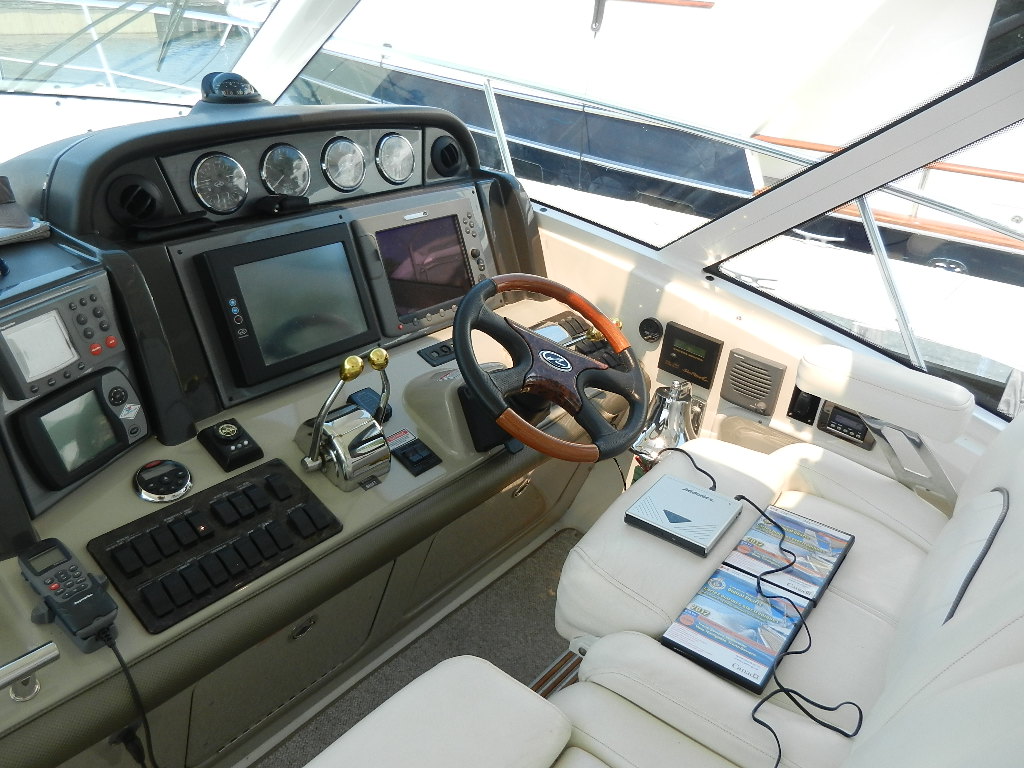
At 10:00 AM on Tuesday morning, we caught up with our mail, which contained the electronic charts for the Trent Severn Waterway, the Georgian Bay, and the North Channel.  This required loading two disks to the Sea Ray Navigator II, our Windows based touch screen navigation system.

The loading process took about 30 minutes and involved calling the vendor to get an authorization number.  Talk about copyright protection, I had to give the vendor the product code on the box and another code produced by the system before they would give me the final code.  The process went smoothly except for the fact that it was 90+ degrees.

Portable hard drive hooked up to the Sea Ray Navigator
While we were at the Oswego Marina we met two couples who were also doing the loop, Ron and Sharon from the Blue Heron, a Marlow 57E, and John and Mary on the 38 foot Sea Ray Mary Francis and Ron's friend Rick.  We enjoyed dinner with them at a local restaurant on Tuesday evening and then adjourned to the Marlow to swap great loop, flying and National Guard stories.

Written by Les.

Navigating on the Erie Canal - Schenectady to Brewerton, NY


I've got a mule,
Her name is Sal,
Fifteen years on the Erie Canal.
She's a good old worker
And a good old pal,
Fifteen years on the Erie Canal.
We've hauled some barges in our day
Filled with lumber, coal and hay
And ev'ry inch of the way I know
From Albany to Buffalo.

Low Bridge, ev'rybody down,
For it's Low Bridge,
We're coming to a town!
You can always tell your neighbor,
You can always tell your pal,
If you've ever navigated
On the Erie Canal.

The Erie Canal that we experienced was very different from the song.  There were no mules, no low bridges, no colorful towns, no commercial traffic, no navigation (to speak of) and no pals (i.e., other Loopers).  None.  Here's a short history.

The first interation of the 363 mile Erie Canal was started in 1817.  It was 40 foot wide at the top, 28 feet wide at the bottom with a depth of 4 feet.  There were 83 locks (90' long by 15' wide) and 18 aqueducts.  The canal raised boats 565 feet from the Hudson River to Lake Erie.  The cost was $7,000,000 in 1817 dollars.  It was the undisputed engineering marvel of its day.

The canal was enlarged 27 years later (1862) at a cost of $32,000,000.  Now the depth was 7 feet and the canal was wider (70' at the top, 42' at the bottom).

The version that we traversed was completed in 1918 at a cost of $150,000,000.  This route linked the canal to the Mohawk River creating a wider and deeper route, which was a result of steam engines replacing the mules.  The locks were made larger (328' long by 45' wide) and the number was reduced to 35.  Much of the route was changed.  There are only a few places where the new canal covers the same ground as the original.

Guided Discovery parked next to a remnant of one of the original 18 aqueducts
The canal was originally created as a commercial waterway to link New York City to the mid-western cities on the Great Lakes.  It served that purpose until competetition from the railways and later trucking made the canal less desireable as a way to move goods - not to mention that it froze up during the winter.  Today, there is no commercial traffic on the canal.

Today the canal is totally for recreational boats.  That said, we traversed a total of 21 locks on the Erie and 8 locks on the Oswego Canal and encountered no other recreational boats moving west.  We went through all 29 locks all by ourselves.  Further, we experienced no delays at the locks.  This was a totally different experience that the western rivers where commercial traffic had first priority and there was lots of barge traffic that caused us to wait at many locks.

The Erie locks themselves were also easy, with lines position every 20 feet and cables that we could run a line through.  The lockmasters were incredibly efficient.  For example, they would have the doors closed before we were position for the lift (or drop) and would operate the lock as soon as we were ready.  They also called ahead to alert the next lock, which resulted in the doors being opened when we arrived.

The scenery was pastoral.  The canal and the Mohawk River were lined with hills and trees.  Occassionally we could see the mountains.  The cities are far apart and for the most part not easily accessible.

Houses along the canal were an unusual sight
We entered the canal on Friday, July 13 at Troy and traversed 7 locks stoppingt at Schenectady.  The highlight of that day was a 2.5 mile dingy ride to dinner an the Lighthouse Restuarant.

Lighthouse Restaurant in Schenectady
From Schenectady, we traveled 6 hours, 51 miles and 8 locks to St Johnsville, NY, a town with a population of 1,700.


St. Johnsville was an interesting study in relation to the unemployment problem facing the US.  (Interesting relevant fact: Since 2000, 42,240 factories have closed in the US representing a loss of 5.5 million jobs and a loss of 32% of the US manufacturing capability.)  Several plants closed in St. Johnsville including a shoe and dying, the latter employing 600 people. 

Remnants of a dying plant in St. Johnsville
The result, a very depressed small town with high unemployment. 


I got the story of the dying factory from Milton Smith, a gentleman who had started working at the plant in 1958 for $1.25 per hour.  Milton explained that the plant moved to the south and then later to China.  Today, Milton lives across the street from the remnant of the plant.

Milton Smith of St. Johnsville, NY
The next day we covered 80 miles and 7 more locks traveling from St. Johnsville to Brewerton, NY (on the western shore of Lake Onieda).  We experienced moderate showers for three hours on this leg of the trip.  Because it was a long day (10 hours) we stopped at Bellany Harbor Park to let Kodi have a break.  Most of the 80 miles were on the canal itself which after Johnsville runs straight and true.


At Lock 20 we hit 420 feet above sea level, whereupon we started our descent to Lake Ontario.

The following are photos from our 25 foot descent at Lock 22.

Lock 22 upstream doors are closed
Viewing the upstream doors when we reached bottom
Departing Lock 22 heading down stream
We arrived in Brewerton, NY at 6:50 PM, launched the dingy and dingied over to a lovely restaurant on the southern bank of the river where we dined alfresco. 

Dining alfresco looking over the Mohawk River at Brewerton
All in all three very hot (90's moth of the time) and relaxed but long days on the water.

Kodi enjoying the peaceful voyage
Written by Les.


Friday, July 13, 2012

Now the Erie Canal

Statistics as of today at Schenectady, NY on the Erie Canal:
  •   4,810 Total Miles since beginning of the Great Loop on 10/3/10  4,908 Total Gallons of Diesel Used
  •        34 Total Locks
  • $3.62   Average Cost of Fuel
  • $85      Average Daily Cost of Dockage
  • 389      Days on the Great Loop
  • $216    Average Cost Per Day
Statistics since leaving Branford Connecticut for Phase II:
  • 238    Miles Traveled Since 7/2/12
  • 167    Total Gallons Used (includes sea trial)
  •     7    Locks
  • 221    Total Lift above Sea Level
On Thursday (7/12) we departed Catskill, NY at 11:13 PM after refueling (187 gallons @ 4.17/gal), pumping out and filling the water tank.  We also reinflated the special 18" ball fenders that we use in the locks using the air compressor at the marina.  With full fuel and provisions we were ready for the next phasre of our journey.

Guided Discovery at the Riverview gas dock


We also dealth with a stow-away (a Black Swallowtail) who left after I opened the vent window.  Note: I collected butterflies as a kid and caught and mounded another of Black Swallowtails.


Four hours later we arrived in Albany, NY and docked at the Albany Yacht Club (name more impressive than the facility) on the east side of the Hudson (actually Rensellear).  This was a slower run as the current was running against us.  That said, we only lost 1 mile per hour. 

Lighthouse on the way to Albany
Given the 90+ degree temperature and the fact that we were some distance from the city, we passed on exploring the downtown.

Last remaining WWII Destroyer tied up in Albany

View of Albany from the Hudson
On Friday morning (today) at 8:15 AM we were on the river again headed for Schenectady on the Erie Canal, which we reached at 9:52 after passing through Watervaliet and Lock 1, at Troy NY (14 foot lift).

Lock 1 on the Hudson

Enterance to the Erie Canal
The next challenge was Locks 2 through 6, which altogether raise us 169 feet.  These are big lifts, averaging 33 feet each, and this all takes place in a mile and a half.  We traversed these five locks in 91 minutes, largley due to the fact that we were the only boat using the locks and the incredible efficience of the lock operators.

Entering Lock 3 on the Erie Canal
Once we cleared lock 6 we were on the Mohawk River, where we traveled for 2 more hours to Schenectady (including Lock 7 with its 27 foot lift).  All in all, we had lifted 221 feet in a total of 7 locks.  We docked at the Schenectady Yacht Club at 1:40 PM.

Guided Discovery at Schenectady rigged for lock running
We spent part of the afternoon entertaining Kodi.  It started when Diana took Kodi of leash.  Kodi immediately headed into the water and got muddy.  Oops.  Time for a bath.  Before the bath, we let Kodi swim off the boat, which involved taking the dingy of the swim platform.  Kodi had a great time.  However, all good things must come to an end.  We then gave Kodi a well deserved bath.


Around 5:00 PM, Kodi and I dingied 2 miles west to explore the city when we discovered the The Waters Edge Lighthouse Restaurant right on the river. Ileft Kodi on a porch by the bar enterance while I went in to check the menu.  When I returned to Kodi she was engaging four of the wait staff who had voluntarily brough her a bowl of water.  We then entertained the them with our classic repetoir of Kodi tricks, which including her counting to all number between one and five and reteiving objects (her collar and leash in the correct order).


The Waters Edge Lighthouse Restaurant
At 6:30 PM, Diana and I dingied back to the Lighthouse for a spectacular dinner.  It was great fun speeding up and down the flat water at 20 MPH.

Written by Les.


Wednesday, July 11, 2012

A busy day

Today (Wednesday), we planned a very agressive day with a drive back to Hyde Park to visit Franklin Delano Roosevelt's bithplace (Springwood), the FDR Presidential Library and Eleanor Roosevelt's Val-Kill home followed by a 40 mile cruise on the Hudson from Poughkeepsie to Catskill.

Immediately, I discovered a problem.  I had lost my Maui Jim prescription sunglasses ($1,000).  I had a sense that they were lost during our visit to the Vanderbilt estate yesterday but at 7:00 AM there was no way to check with the Visitor Center.

The next event was an early morning walk with Kodi toward downtown Poughkeepsie.  The plan was to leave her on the boat. 

At precisely 9:00 AM we called the Vistor Center and got some great news.  My glasses had been found ... HURRAH.  So off we went at 9:00 AM to retreive the glasses.  More good news.  The Vanderbilt Estate is only two mile up the road from FDRs home.

After retreiving the glasses (undamaged), we drove over to Springwood and took the 10:00 AM tour.  Again, the National Park Service guide did an excellent job of describing the property and the Roosevelt history.

Springwood, FDR birthplace and home
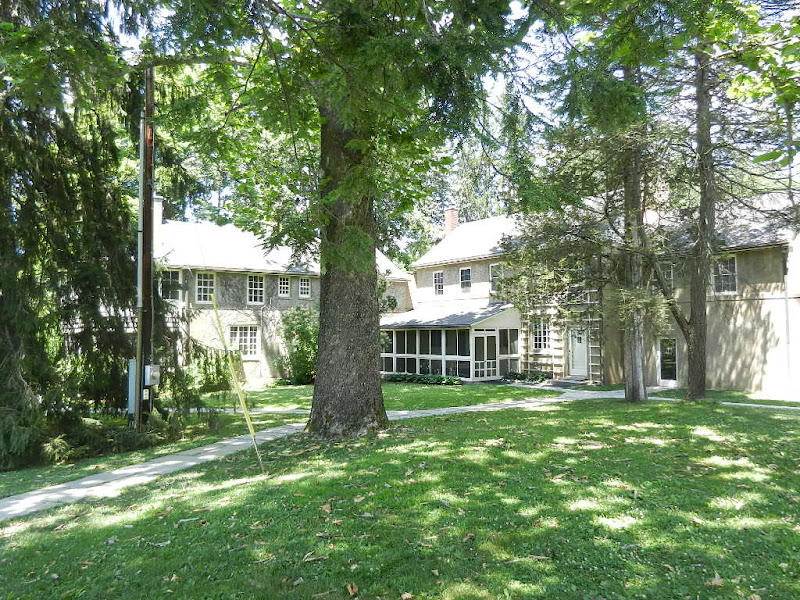
An interesting fact is that Franklin and Eleanor lived with Franklin's mother, Sara, who was a very powerful influence throughout his life.  Note: She made the cover of News Week (as it was called then) two times.  The house itself was very nice but modest in comparison to the Vanderbilt estate.  The guide explained it as old money versus noveau rich.

Springwood Foyer
Sprinwood living room
FDR was born in this room
FDR faced two major challenges in his presidency, the great depression and WWII.  The former produced a series of accomplishments in the first 100 days that forever changed the vrole of the Federal Government.  The latter forever changed the role of the US as a world leader.  What comes across in the tour is that Eleanor was a big factor in the success of his presidency,  What also come across is Eleanor's role as a political leader after his death. 

Unfortunately, the Presidential Library was closed for renovations, so we drove 2 miles east to Eleanor Roosevelt's Val-Kill home and caught the 12:30 PM tour.  Again, an hour tour and again an excellent guide.  Val-Kill was given to Eleanor Roosevelt as part of a deal to avoid a divorse due to FDR's infidelity.  Part of the deal was that when FDR was in residence, Eleanore stayed at Springwood.  Otherwise, she lived at Val-Kill.

Modest entrance to Eleanor Roosevelt's modest home

Val-Kill from the back where you can see that it was once a factory
Val-Kill was originally a factory that the Roosevelts converted into a home.  What strikes you is that how modest the home, especially given the fact that many US and world leaders were entertained in this home such as Prime Minister Nehru, The King & Queen of England and JFK (when he visited with Eleanor to get her endorsement.  Check out these photos:
Eleanor Roosevelt's study
Eleanor Roosevelt's dining room

Eleanor Roosevelt's living room
At 2:00 PM we returned our Avis rental car and the representative very generously drove us back to the boat.  Then had a GREAT lunch on the veranda of Shadows and at 3:45 PM we departed their marina for Catskill.  Perfect weather and another push from a rising tide got us into Catskill in under 3 and a half hours on 17.7 gallons (to cover 37.6 miles).

We arrived at Riverview Marine Services at 7:20 PM to end a very busy perfect day.

Guided Discovery at Riverview
Written by Les.

Tuesday, July 10, 2012

Chasing the Vanderbilts

Tuesday morning, Kodi and I walked into downtown Poughkeepsie (a 3 mile round trip).  The weather was perfectwith temperatures in the low 80s and Kodi was on her best behavior.
Kodi poses for a photo
Downtown Poughkeepsie itself was less than perfect.  I estimate that as much as 30% of businesses were vacant indicating signs of a recession in this city.

A row of vacant business close to downtown
 That said, there were some interesting sights.


Corner of Main and Market

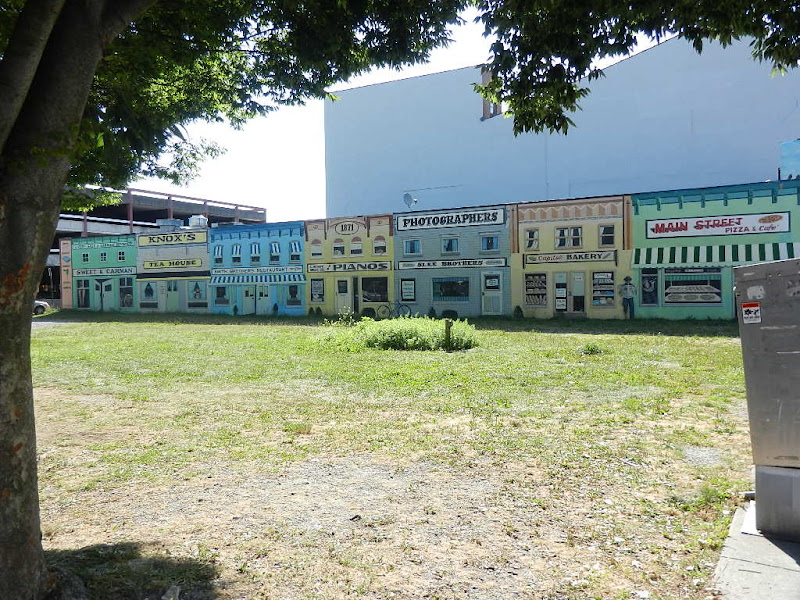
Side of a building painted as individual businesses
National Guard Armory (for sale)
Theater on Market Street
Our Tuesday afternoon activity was a visit to the Fredrick Vanderbilt estate in Hyde Park (7 miles north of Poughkeepsie in a rental car), which is part of a two day strategy to also visit FDR's home and Presidential Library along with Eleanor Roosevelt's Valkill estate. 

Fredrick Vanderbilt's Hyde Park Estate
Fredrick Vanderbilt built this home in 1898 at a cost of 2.4 million dollars.   The estate is considered modest by Vanderbilt standards.  Cornelius' Breaker and William Henry's Marble House in Newport, which we visited last summer were far more elaborate.  That said, 2.4 million in 1898 bought quite a home (which is $657,000,000 in today's dollars).  Note: We also visited the Biltmore estate in Asheville NC a few years ago,)

Fredrick was on of William Henry's 7 children.  Fredrick received an inheritance of $10,000,000 at his father death, which he built to $78,000,000 at the time of his death (which was as high as $132,000,000 prior ot the crash).  Fredrick went on to run the Vanderbilt railroads.

This summer / fall home had 60 servants, 20 0f whom worked inside the house.  Noteworthy is that the Fredrick and Louise had no children.  The home was inherited by Louise's neice, Margaret Van Alen, who donated it to the federal government (with the help of neighbor, FDR) in 1940.  This is a national treasure that reflects the era before the Fedaral Income Tax cooled the elaborate lifestyles of the then 1% (who controlled most of the ealth in America).  

The tour guide, Josh, was one of the best we've encountered in our year of traveling.  His knowedge and enthusiasm were infectious.  He got the loudest round of applause of any tour guide we've seen. 


Here are some interior photos.


Tomorrow we visit FDR's home and Presidential Library.

Written by Les.